Showing posts with label Drosera. Show all posts

Saturday, July 11, 2020

Quiet Corner Carnivores

Drosera intermedia and a few D. rotundifolia on an old pine log in a pond in Union, Connecticut.
Much of northeastern Connecticut is underlain by thin soils and washed glacial sands and gravels, derived from nutrient-poor gneisses and other old metamorphic rocks. These poor, acidic subtrates create habitats for a variety of carnivorous plants in local bogs, seeps and ponds.

Drosera rotundifolia with freshly caught fly. 
We have two native sundews in the Quiet Corner. The Round-leaved Sundew, Drosera rotundifolia, is the more frequently encountered species. It usually grows in sphagnum moss in bogs or on the shores of ponds, but sometimes establishes on rotting, soggy conifer logs or sandy seeps. The Spatulate-leaved Sundew, Drosera intermedia, is most often seen in very wet, peaty mud in bogs, and usually not in living sphagnum moss, though it sometimes grows in damp sand or on fallen logs in ponds, alongside D. rotundifolia. Three other species of Drosera occur in New England, but not as far as I know in Connecticut: D. anglica and D. linearis are boreal plants restricted to the far north of the region. Drosera filiformis occured in the past on the coastal plain in southern New England, but seems to have disappeared, outside of several extant populations out on Cape Cod.

One of the largest individual plants of Drosera rotundifolia that I have ever seen, almost 20 cm across, in a small, isolated sphagnum bog back in the hills of Union, Ct. Other sundews in the area were of more typical size (5-10 cm diameter rosettes), and I suspect this one simply happened to find itself alone with no competition in a particularly favorable spot. 
Woodland sphagnum bog hosting Round-leaved Sundews in Union, Ct. Photo taken in mid-June, when the Mountain Laurels (Kalmia latifolia), state flower of Connecticut, were flowering.  


Drosera rotundifolia on a waterlogged Eastern Hemlock trunk in Union, Ct.
Sarracenia purpurea on the shore of a pond in Union, Ct. 


 Sarracenia purpurea, the Purple Pitcher Plant, is the only member of its genus that is native north of Virginia. There is an old herbarium record of one of the southern species, S. flava, growing naturalized in Mansfield, Connecticut, but have checked the site and there is no sign of anything but the native S. purpurea now. Compared to the local sundews, S. purpurea is much more exacting in its habitat requirements, only occurring in sunny sphagnum bogs or other open sites with live sphagnum moss.
Sarracenia purpurea on a floating island of sphagnum and other vegetation. The site is inaccessible except by boat or swimming; through a zoom lens from the shore the tall fruiting shoots are the only parts of the plants that are easily visible.
Utricularia radiata in a slow moving marshy stream in Eastford, Ct. Underwater shoots with bladder traps are visible to the right of the flowers.  


 Aquatic bladderworts are the most common and diverse carnivorous plants in northeastern Connecticut, with one or more of about five different Utricularia species being found in just about every lake, pond, kettle hole, sluggish stream or marsh in the area. An agricultural or ornamental pond has to be pretty badly abused before the ubiquitous U. gibba disappears. Utricularia radiata, with its aerial flowering shoots held up by distinctive star-shaped floats, seems to show up mostly in more pristine sites with cleaner water.

Another pine log community with Drosera intermedia and D. rotundifolia. See if you can spot the medium-sized snapping turtle guarding the carnivorous plants from curious waders.  

Sunday, September 30, 2018

New England Carnivorous Plant Show 2018

A carnivorous plant fairy garden. It's kind of implied that the local fairies aren't the brightest bulbs on the tree.  
Earlier this month, the New England Carnivorous Plant Society held its annual show at Tower Hill Botanic Garden near Worcester, Mass. There were nearly 2000 visitors for the weekend, which is a little down from recent years, but still impressive for a specialist plant show.

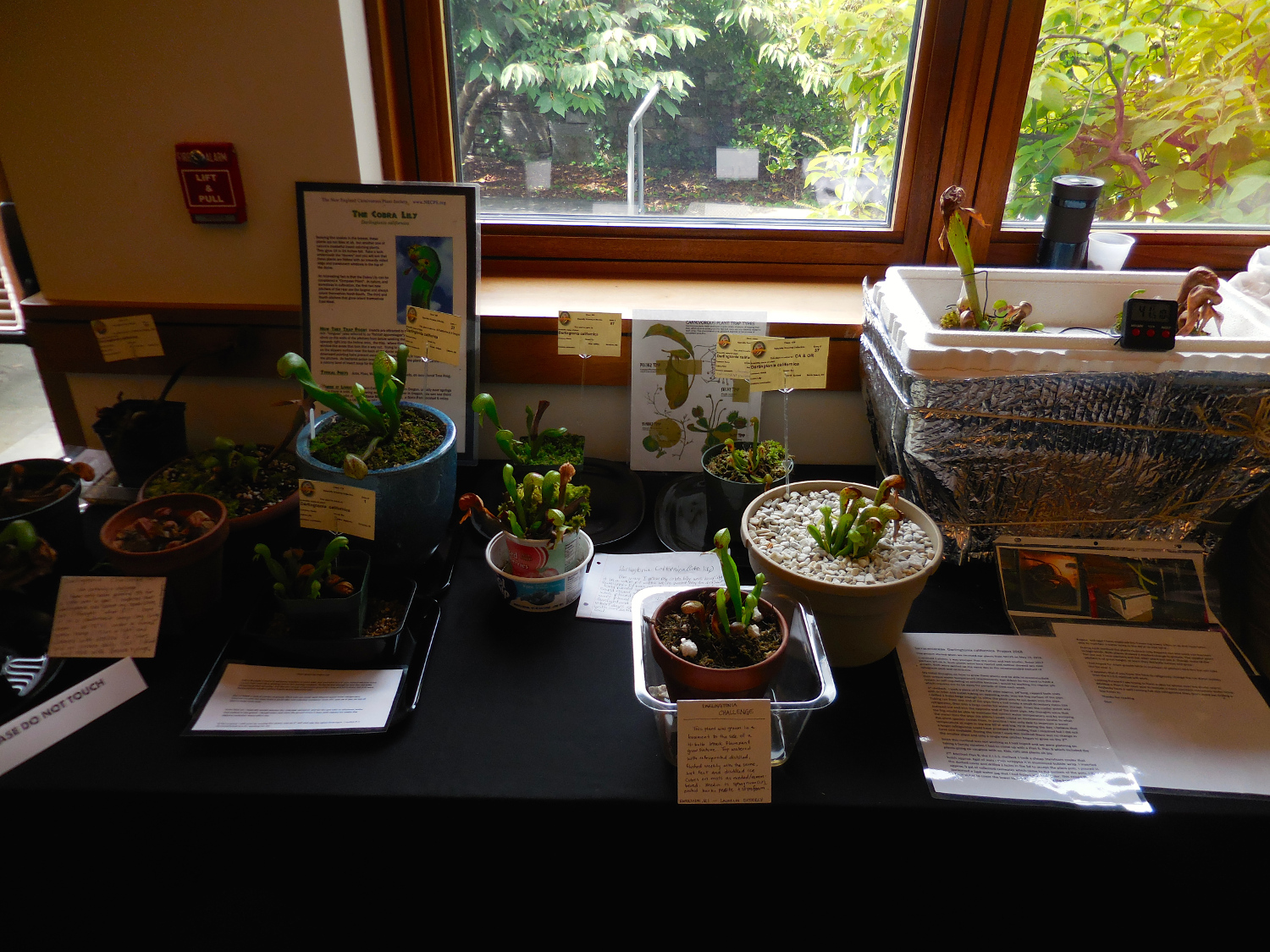
Darlingtonia californica.
One of the special events at this year's show was the Cobra Lily Challenge. In general, Darlingtonia, the Cobra Lily, is difficult to grow in the Northeast and is poorly represented in shows. So back in June, the NECPS distributed divisions of Darlingtonia to interested members, in exchange for a promise to bring the plants back to display in September.

The Cobra Lily Challenge display. 
The main issue with cultivating Darlingtonia in this area seems to be that the plants like their roots kept cool, and suffer in hot muggy weather, especially when temperatures stay warm all night. People have tried various tricks, like irrigating with ice water or keeping plants in air conditioned terrariums, but the some of the best results were with plants grown mainly outdoors, but protected from the worst of this summer's heatwaves by, e.g., bringing them temporarily indoors in air conditioned spaces under lights.

Drosera, Drosophyllum, Utricularia and others in the show. 

Sarracenia leucophylla. 
There were a number of interesting talks at the show, in particular a presentation by Prof. Larry Mellichamp of the University of North Carolina, on the question of how the American Pitcher Plants (Sarracenia)  avoid trapping potential pollinating insects. The various species of Sarracenia produce pitcher traps and flowers at different times of the year, separated at different heights, and/or with different attractants that draw in separate populations of prey insects and pollinators. Sarracenia leucophylla, for instance, produces dark maroon, bumblebee-pollinated flowers in spring, while its largest, most effective traps emerge in summer and autumn, and use sweet odors and pure white coloration to attract moths at night.

Friday, May 20, 2016

Carnivorous Plant Meeting at UConn

Carnivorous plant collection at the UConn Ecology and Evolutionary Biology Teaching and Research Greenhouses.
The New England Carnivorous Plant Society held their May 14 meeting at the University of Connecticut. Activities included a tour of the botanical teaching collections, which include a good selection of carnivores. After the business portion of the meeting was concluded, some of us headed to the Dunhamtown Forest preserve, less than a mile from the center of campus, to look for some of the local carnivorous plants and other spring wildflowers. 

Dunham Pond, Storrs, Ct.
We hiked on the trails to the bank of Dunham Pond. The pond is a natural body of water, and is probably a kettle pond dating back to the last ice age, formed as a depression left behind by the melting of a large residual mass of ice left behind by the glaciers. Dunham pond hosts several species of aquatic Utricularia (bladderworts), but it was too early to see any sign of these. Purple Pitcher Plants (Sarracenia purpurea) also grow in the preserve, but in a very difficult to access swampy thicket, so we didn't get chance to visit them this time. There is an old herbarium record of Sarracenia flava, one of the large, upright southern pitcher plants, naturalized at Dunham Pond. These must have been planted out by a local botanist, and there is no sign of them surviving today.

Arisaema triphyllum, Jack-in-the-Pulpit, in the Dunhamtown Forest.
Various spring wildflowers were in bloom along the trails, such as Canada Mayflower, Wood Anemone, and Jack-in-the-Pulpit, one of our local aroids. People often misidentify the inflorescences of Jack-in-the-Pulpit for pitcher plants, but no one from the NECPS was going to make a rookie mistake like that.

Drosera rotundifolia, the Round-leaf Sundew.
In the end, the only carnivore we saw at Dunham Pond was Drosera rotundifolia. This is the only sundew (of two potential local species) that occurs at the site. The plants were fairly abundant on Sphagnum moss tussocks, and sometimes growing directly in rotting wood on waterlogged fallen tree trunks.

Sarracenia purpurea in Willington, Ct.
A few of us took a break after the walk at the UConn Dairy Bar, and decided to head to another nearby bog, in Willington, Connecticut, to see Purple Pitcher Plants. The bog, a classic site for UConn biology field trips, is a floating Sphagnum mat with one of the most vigorous populations of S. purpurea that I know of, and also plenty of Round-leaf Sundews. It was a little early for the pitcher plants, which were just starting to produce flower buds and only had overwintered pitchers from last season. 
Rhododendron canadense, Rhodora, in early May, Willington, Ct.
Rhodora, a Rhododendron of bogs and swamps in the Northeast was in full bloom. This low shrub was growing in a couple of scattered spots on the Sphagnum mat, among the pitcher plants and a much more abundant ericaceous shrub, Chamaedaphne (Leatherleaf).

Thursday, November 12, 2015

Carnivorous Plant Talk

Sarracenia purpurea, the Purple Pitcher Plant, at a quaking sphagnum bog in Willington, Connecticut.
 This Saturday at 1:00, I'm going to be giving a talk at the Connecticut State Museum of Natural History in Storrs. The presentation is going to cover "Carnivorous Plants in Connecticut and Around the World," and will include a basic introduction to the concept of insect-eating vegetation, a whirlwind tour of the different genera of carnivores, and then a look at some localities in my area where some of the dozen or so species of native Connecticut carnivorous plants grow. I'll also bring along a selection of live plants for some demonstrations after the slide show portion of the talk is finished.  

Drosera rotundifolia, the Round-leaf Sundew, growing among cranberries in a sphagnum bog in Windham, Ct.
The C.P. talk has been announced in several news outlets, including the Hartford Courant and local free alternative paper Neighbors. I think that these Museum talks usually get a pretty good turnout, so it should be a fun afternoon.

Friday, July 31, 2009

Hail to the King, Baby

Drosera regia in cultivation in Connecticut, June 2009. Leaves about 40 cm (16 inches) long.

Drosera regia, the King Sundew, is one of the giants among carnivorous plants, apparently growing close to a meter tall in some situations. Its natural range is a small patch of mountainous terrain north of Cape Town, South Africa, and it occupies an evolutionarily isolated branch of the sundew family tree, being the only surviving representative of a very early-diverging lineage. King Sundews are uncommon in cultivation, having a reputation for being slow-growing and temperamental. These plants at the University of Connecticut were started from seed collected in Bainskloof, South Africa, and are flowering for the first time at age 4.

Drosera regia flower.

I had several individual King Sundews flowering at the same time, so I cross-pollinated them. Six weeks later, the first seed capsules have started to ripen, and it looks like pollination was successful. Even seeds are big in D. regia: about the size of poppyseed, which is gigantic by Drosera standards.

Drosera regia, ripe capsule and seeds (pencil tip for scale).

Sunday, June 14, 2009

Carnivorous Plants at Tolland Marsh Pond

Tolland Marsh Pond, May 31, 2009. Sarracenia flower at lower center.

Tolland Marsh Pond is a rather large (half a mile north to south) wetland, located in my neighborhood in the northeastern corner of Connecticut. The waters of the pond itself are acidic and dark, and ringed with a wide swampy margin of sedges, sphagnum moss, and thickets of blueberry and buttonbush. This is the kind of place where carnivorous plants grow, and in a recent trip to the pond I managed to find several different species of insect-eating greenery.

Sarracenia purpurea ssp. purpurea. Note mosquitoes in lower left pitcher; these may be Wyeomia smithii, a pitcher plant commensal.

The most impressive carnivorous plant native to New England is the Purple Pitcher Plant, Sarracenia purpurea. The pitcher plants were in full bloom when I checked them in late May. The dark maroon flowers attract pollinating bees, and are held well above the modified, water-filled leaves.

Sarracenia purpurea flower, about 2 inches across.

The leaves are the business end of the plant; the part that actually traps and kills insects, then breaks them down in order to obtain nitrogen and other nutrients that are in short supply in bogs. Unlike some carnivorous plants, Sarracenia purpurea does not move. Prey is attracted by the coloration of the leaf and nectar that it secretes. Unlucky critters slide into the pool of liquid inside, drown and are digested by bacterial action.

Pitcher plants and cranberries. The fruit must have come through the winter, but it was still edible, if a bit mushy.

At Tolland Marsh Pond, pitcher plants are present in a few open, boggy areas, but don’t seem to be tremendously abundant. I’ve seen a few dozen plants, but there are large areas of potential habitat that I haven’t checked.

Drosera rotundifolia. A few plants of this species are visible in the cranberry photo above, too.

Drosera intermedia favors wetter, muckier parts of the bog.

The pond is also home to both of the species of sundew that occur in inland Connecticut, Drosera rotundifolia and D. intermedia. Sundews have glandular tentacles on their leaves that secrete sticky mucilage, and trap small insects. The tentacles and leaves slowly fold around and digest their prey. Drosera rotundifolia grows all around the pond in sphagnum moss, or on half submerged waterlogged wood. Drosera intermedia isn’t as widespread, and I saw just a few patches of it in mucky peat in open areas on floating mats of moss and vegetation.

Tolland Marsh Pond: edge of the marshy parts of the area viewed through laurel thicket, White Oak and Red Maple. There is a pond out there, but you can't see it from here.

Tolland Marsh Pond isn’t easily accessible, which does have the beneficial effect of limiting the number of visitors to a fairly fragile habitat. There are a few informal trails around the pond, but my botanizing has involved a good deal of bushwhacking through laurel thicket (Mountain Laurel is pretty, but it is a slow and scratchy process to cross a dense stand of it). The marshes where the carnivorous plants occur are treacherous as well, with floating hummocks and sphagnum mats providing doubtful footing over sunless water and peat slurry of indeterminate depth. Tolland Marsh Pond also has Poison Sumac (Toxicodendron vernix), which is a bit like Poison Ivy, but twice as toxic and as tall as a lilac. Nasty, nasty stuff, which normal people will fortunately never run into, since it is almost entirely confined to bogs.

Tolland Marsh Pond, January 2009.

Sarracenia purpurea is evergreen, and although the leaves are low to the ground and can be hidden by even a little snow, the old seed heads are distinctive and fairly tall. So, winter is a good time to explore bogs for Purple Pitcher Plant populations. Places that are inaccessible in summer--too solid to be navigable by boat, but too unstable to negotiate safely on foot--can be reached by an easy walk after a long cold spell has frozen the landscape solid. And, there are no leaves on the Poison Sumac to worry about brushing up against.

Two Sarracenia purpurea flower stalks sticking above the snow (lower left and center).

I first found pitcher plants at Tolland Marsh Pond by taking advantage of good conditions for frozen bog walks this past winter. It would have been easier to find the plants if there hadn't been so much snow, but the old seed heads are fairly easy to spot, and seem to persist well into the cold season. There were even seeds still present in the capsules in January.

A little digging reveals the rest of the plant. Sarracenia purpurea leaves tend to turn solid red in winter, possibly to protect against light damage while the plants are dormant. The pitcher plants that I've seen in winter at Tolland Marsh Pond were close to open water in the center of the wetland, while the ones that I've been able to check on in summer were near solid land around the edge. In between, there is a stretch of possible habitat where I haven't looked. Time to think about another expedition!