Friday, October 31, 2025

A Visit to Dark Swamp

The edge of Dark Swamp.

 Out east on the Putnam Pike in Glocester, Rhode Island, on the border with Connecticut, there is a neglected patch of wild land with an eerie reputation: Dark Swamp. In November 1923, H.P. Lovecraft and fellow horror writer Clifford Martin Eddy Jr. attempted to travel to the swamp to investigate local legends of supernatural occurrences and nameless creatures. Although the authors never managed to find their way into the swamp itself, the lore and the atmosphere of the area may have helped inspire stories like The Dunwich Horror and The Colour Out of Space, and Lovecraft's letter about his trip to the vicinity of Dark Swamp is the main conduit through which knowledge of the legends of the swamp has survived to the present.   

Dark Swamp is located near the western edge of Glocester, RI, between Reynolds Rd and Willie Woodhead Rd, on state forest land associated with the Durfee Hill Management Area. I visited in December last year, starting on foot from the small parking area at the end of the paved northern section of Willie Woodhead Rd, and seeing the sights of the swamp from the maze of footpaths and wood roads west of W.W. Rd, with some bushwacking into interesting-looking locales. Logging and hunting takes place in the state forest, and a sign suggested that wearing blaze-orange is required for entry during hunting season. 

The inexplicably named, semi-impassible unpaved middle section of Willie Woodhead Rd, east of Dark Swamp. 

 The rough, hilly landscape in and around Dark Swamp is pretty typical of southeastern New England. The bedrock is the hard, pale granite of Avalonia, an ancient island arc pasted onto parts of coastal North America during the formation of Pangea. The soil is thin and acidic and mostly made of rocks. The uplands support a stunted, scraggly forest of White Pine, Pitch Pine and a half a dozen different oak species, with an understory of various blueberries, huckleberries and shadbushes, with mountain laurel and impenetrable tangles of catbrier here and there. This vegetation type is known as Oak-Heath Forest, and is found on poor, well-drained soils in the eastern US, mostly not too far from the sea. Low-lying areas are dominated by Eastern Hemlock and Red Maple, with an understory of highbush blueberries and Sweet Pepperbush. Lovecraft found the landscape of the rural Glocester hills, woods and isolated farmsteads to be uncommonly beautiful, and it still is lovely, but good lord imagine trying to make a living from agriculture on soil like that, in an era before powered equipment and chemical fertilizers.     

Grave of the infant Eliza Ann Bowen.

Cellar hole just east of Dark Swamp.
 Dark Swamp was not quite as shunned by humanity as Lovecraft suggests, and there are remains of 19th Century inhabitation on the eastern margins of the swamp. A small but still regularly maintained cemetery has graves from the Bowen family from the mid eighteen-hundreds. A little further south there is an early fieldstone cellar hole from a farmhouse, including the base of a massive central chimney, with surrounding stone walls and the remains of outbuildings. The buildings were electrified at some point in the 20th Century, and probably would have been standing and occupied in the 1920s for Lovecraft's visit, if he had managed to reach the area. 

A deep dug well next to the farmhouse ruins.

Flash photo down the well. 

Next to the cellar hole there is a deep dug well, lined with stone and with a pool of clear water at the bottom, maybe 20 feet down. It was strongly reminiscent of my image of the contaminated well in Colour Out of Space, but of course every lonely farmhouse in New England in the 18th, 19th and early 20th centuries would have had something similar. This particular example was quite well-preserved and deep; they are often shallow and collapsed or choked with debris when you run across them in the woods. 

Large cairn near Dark Swamp. 

Group of big cairns in a hollow between low ridges. 


One of the peculiar features of the Dark Swamp area is the unusual prevalence of cairns, or lithic sites. There was a striking group of about 20 large cairns, some almost as tall as me and 12-15 feet across, deeper in the forest in the vicinity of the farmhouse ruins, scattered around the floor and sides of a small hollow. These sorts of things could be prehistoric ceremonial grounds from Native Americans, or the product of the land-clearing efforts of settlers, or something else, but the large number and size of dry fieldstone structures at this spot was odd.   

Barren field of sand near Dark Swamp. 

 Another peculiarity of Dark Swamp is a rounded patch of barren sand, about an acre in size and easily visible in satellite photos of the swamp, with almost no living vegetation within its perimeter. This will immediately bring to mind the "Blasted Heath" in Colour Out of Space, though Lovecraft did not mention having heard of this particular sand field, if indeed the site existed in its blasted state in the 1920s. Could this be a place where blasphenous sacrifices to the Old Ones have been performed on May Eve, and the veil between worlds is worn thin, and malign influences from beyond the stars seep into our sphere, such as naught that is of our world may long endure? Or, might it be that, since time immemorial, drunken Swamp Yankees have gathered at an old sand pit, on May Eve, to drive their ATVs around in circles, thus killing anything that starts to grow in an already challenging micro-environment for the establishment of vegetation? One shudders at the mere contemplation of the possibilities.  

Dense stand of Atlantic White Cedar in Dark Swamp. Now that, my friends, is a dark swamp. 

 Much of the actual Dark Swamp is not dark at all, at least not now. There is a whole complex of wetlands that make up what I suppose is the Swamp, with watery low areas separated by hillocks and eskers of glacial outwash sand and gravel; most of these wetlands are sunny and open, with cattails and sedges around shallow pools. There are a lot of dead trees, sun-bleached and bark-less, both fallen and standing, in the open marshy areas, though, and it is clear that 100 years ago the majority of the swamp was shaded by thick growths of pine, hemlock and Red Maple. Likely what has happened is that beavers returned in the mid-twentieth century--after having been hunted to local near-extinction in colonial times--building dams and raising water levels in parts of Dark Swamp, either drowning or straight-up eating the trees that had made the swamp dark. There are still some suitably dismal corners of the Swamp with dense tree cover, though, including a cedar swamp with some real old-growth looking specimens of Atlantic White Cedar and a deep spongy bed of sphagnum moss, which hint at how this half-forgotten corner of Rhode Island earned its name. 


Sunday, April 13, 2025

40th Annual Connecticut Cactus Show

The Connecticut Cactus and Succulent Society's show and sale is happening this weekend, at the Bristol Community Center. The weather was pretty sketchy Saturday morning, with wet snow overnight and some accidents on the highways, and cold rain during the day. That may have depressed turnout a bit, but there were still plenty of enthusiastic visitors. YouTube plant vlogger Summer Raine Oakes stopped by to document the show and interview some cactus club members, so there should be a nice mini-documentary about the event on her channel soon.


Wednesday, October 23, 2024

Comet Tsuchinshan–ATLAS

Comet C/2023 A3 (cafuego. Wikimedia Commons)

 Comet C/2023 A3 Tsuchinshan-ATLAS has been visible in the evening for me for the past week or so. It's in the west for an hour or so after it gets dark. It's visible to the naked eye as a faint white streak, but much easier to see and and a more interesting sight with binoculars. The comet is getting less problematic to catch in some ways: it's further from the sun and higher in the sky, and the moon is rising later and waning, so the sky is darker for comet-viewing. But, the comet is definitely starting to fade and get smaller, at the same time. At it's best it was quite a nice comet, but still not nearly as bright and obvious as Hale-Bopp in 1997. 

Update: as of October 26, I can still find the comet with binoculars, but it's getting small and dim. I can't see it at all without binoculars, even knowing exactly where to look.

It's been a big month for astronomical happenings in New England, with the aurora borealis also making a rare appearance on a couple of nights. I caught them as kind of a diffuse pink glow in the sky. You can apparently see more structure with a camera with a good long-exposure astrophotograpy mode.


Friday, July 12, 2024

Eclipse Solargraph


Mansfield, Connecticut, looking to the south, April 8 to June 20, 2024.

 My solargraph of the 2024 eclipse, plus the next two and a half months through the summer solstice, turned out pretty well, but I'm not sure if I can really make out any eclipse dimming. Theoretically, the lowest sun track in the sky includes the April 8 partial eclipse, but it kind of blurs into the sunny days in subsequent, higher tracks. Plus, the sun is off the top of the picture in the early afternoon, when the eclipse probably was starting, because the camera wasn't pointed upwards enough. 

In the solargraph, permanent, stationary objects in the landscape, like trees, are visible in the lower part of the image, while the sun's paths in the sky over the course of the exposure are the arcs in the upper part. Sunny days show up as bright arcs, while cloudy periods (or eclipses?) leave dark bands. 

The solargraph was made in a soda-can camera obscura with a pinhole to project an image onto a sheet of black and white photographic paper. The actual physical photograph is an upside-down and backwards, pinkish-sepia negative image, burned into the emulsion on the paper. I used a flat bed scanner to digitize the negative, then inverted the colors and flipped the image to get the bluish positive image above. Solargraphic originals apparently can't be developed in the usual chemical way, because the emulsion has been exposed to enough light that it would just turn solid black. There are practical instructions online if you want to try solargraphy yourself. 

Scan of the original negative image.


Sunday, June 23, 2024

Midsummer Conophytum Flowers

Conophytum pageae from southwestern Bushmanland. Nocturnal summer flowers photographed with a flash.

 Plants in the genus Conophytum are all primarily cool-season growers, and most species flower at the start of major vegetative activity in autumn. A few conos bloom at the summer solstice, though: Conophytum frutescens, C. francoiseae, C. minusculum ssp. aestiflorens, C. bolusiae, and certain forms of C. pageae are all flowering for me right now. 

Conophytum pageae has the widest geographic range of any Conophytum species, from the outskirts of the Knersvlakte in southern Namaqualand, all the way north into Namibia. There is a lot of variation in the plants over that range, and many species were separated out from C. pageae in the past. One of the more distinctive former species now considered C. pageae synonyms--Conophytum subrisum--is represented by the photo above. This particular batch of seedlings, from the southeastern part of the range of C. pageae, is a more or less classic "subrisum," with fairly large, greenish-yellow obconical leaves, with red lipstick-like markings late in the growing season, and flowers that are yellow, big and showy. Subrisum flowers also tend to happen very early, before the growing season otherwise starts and even in midsummer, as with these plants. 

There is a definitely an argument to be made in favor of maintaining C. subrisum as a separate species; the trouble is all of the variation and combinations of traits seen in wild populations of C. pageae in the broad, modern sense of Steve Hammer's revisions of the genus. So, there are southern plants that are C. subrisum in every way, except that they flower at the end of autumn, five months later than the population pictured here. Or, there are are plants with good subrisum flowers and leaf coloration, but with small, round plant bodies the size of peas. There are populations with plants that are vegetatively subrisum, but with puny pale-tan flowers reminiscent of the former Conophytum minutiflorum, another C. pageaae synonym. I really don't know what the best taxonomic solution would be in this case; in the balance between trying to name all of the variation seen in nature, and acknowledging that the boundaries between different forms are murky and shifting, maybe the best solution is to sink everything into one wide-ranging and problematically variable species, Conophytum pageae.


Thursday, May 16, 2024

Graves' Beach Plum

Prunus maritima f. gravesii at the University of Connecticut, May 13, 2024
 

For this year's Endangered Species Day I thought I'd post about Graves' Beach Plum, which is about as endangered as a plant can get without being extinct, but which is also arguably not a species. Prunus gravesii was described in 1897, based upon what was likely a single plant with multiple stems, found growing near the shoreline in Groton, Connecticut. Later authors demoted the species to a variety, and then a form, of the widespread Beach Plum, Prunus maritima, and it is now usually referred to as Prunus maritima forma gravesii. 

Graves' Beach Plum native range was always minute, and the wild habitat of the shrubs apparently suffered during the 20th century from development, possible herbicide use, and the spread of invasive plants. By 1998, Graves' Beach Plum was apparently completely gone from its former habitat, extinct in the wild. Some internet sources have it that the little grove of Prunus m. f. gravesii was the only shelter near a beach without facilities, and the area was used as an open air restroom so much that all the plants died, but this seems to be a fairly recently invented legend. 

Prunus m. f. gravesii is extinct in the wild, not extinct extinct, because various botanical gardens and a few private individuals maintain the plant in cultivation. The New York Botanical Garden and the University of Connecticut Botanical Conservatory have kept it going for many years, and UConn has sent plants to the Arnold Arboretum and few other gardens.

Graves' Beach Plum foliage.

Graves' Beach Plum turns out to be charming ornamental shrub for sites in full sun, near the coast or otherwise. In mid-May it is completely covered by small white flowers, which attract large numbers of  bumblebees, mason bees, and other native pollinators. The plants can be propagated with some difficulty by stem cuttings, but more easily by dividing out the suckers that sometimes grow from the roots. Grave's Beach Plum differs from typical Prunus maritima most obviously in its smaller, more rounded leaves, but the entire plant is more delicate than the usual beach plum, with thinner twigs and smaller flowers and fruit. Fruit set in Prunus m. f. gravesii is never very abundant, and it apparently needs to outcross with other Prunus maritima to set seed, so seedlings are never pure gravesii.

Flowering shoots of typical Prunus maritima (top) and Prunus maritima f. gravesii (bottom).
 
Reference: Klooster, M.R. et al. 2018. Resolving the taxonomic identity of Prunus maritima var. gravesii (Rosaceae) through genotyping analyses using microsatellite loci. Rhodora 120: 187-201.
 

Monday, May 13, 2024

The 2024 Solar Eclipse

The April 8, 2024 solar eclipse in progress, through my projector. At least one sunspot is visible off center, and maybe some dust or bugs that got onto the screen. 

I didn't manage to get to northern New England to see totality in last month's solar eclipse, but I did catch about a 93% eclipse in Connecticut, which is enough that the light got pretty dim, shadows looked sharp with diffracted crescent sun images in them, and owls started hooting. It was neat, but nothing like the show when I caught the 2017 Great American Eclipse in South Carolina.

My jury-rigged binocular solar projector, this time with improvised tripod mount and screen.

Eclipse silhouette with button-hole crescent sun image.

Tree trunk shadows with crescent sun images.

Projection of the sun close to maximum coverage.

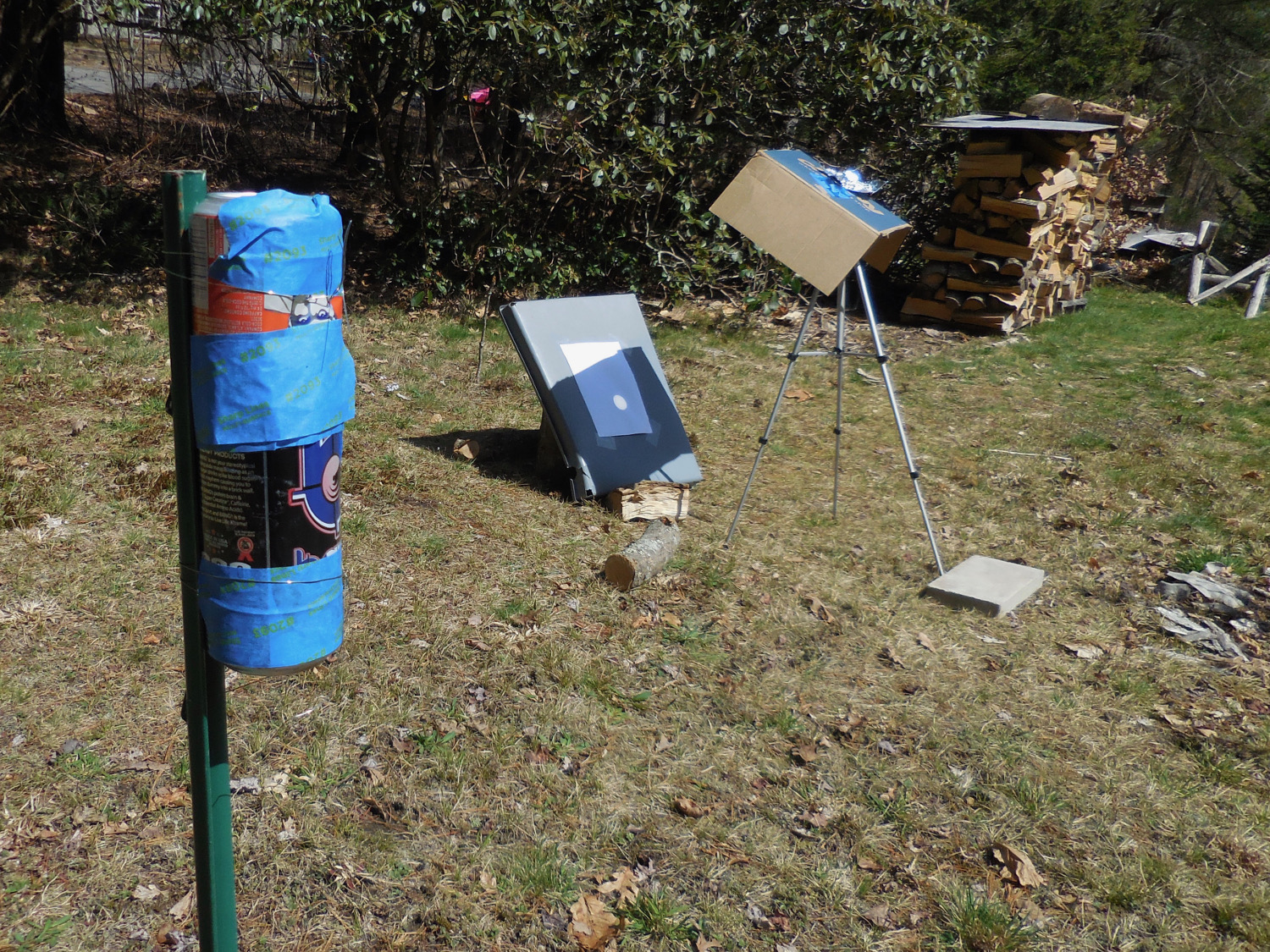
Solargraphy camera recording the action, with binocular projector in the background.

I set up a solargraphy (sometimes spelled "solarigraphy") camera to photograph the eclipse. Solargraphy is the process of using a camera obscura--usually a homemade pinhole camera made from soda cans--to capture photographs on black-and-white print paper, with very long exposure times, ideally resulting in a ghostly image of the landscape with the sun's track visible as streaks in the sky. I'll plan on stopping the exposure around the solstice in June, and will report back with the results then. Hopefully the first, lowest daily solar track in the photo will record a dimming as the eclipse progresses, but I already know that it won't include the sun brightening as the eclipse ended, because clouds moved in shortly after the peak of the partial eclipse at my location. [edited to add: finished solargraph here]

Friday, April 12, 2024

39th Connecticut Cactus Show

Succulents for sale by Rick Logee.

 This weekend, April 13-14, 2024. will be the 39th annual show and sale put on by the Connecticut Cactus and Succulent Society. As in the past few years, the show will be at the Bristol Community Center. There will be a judged show, and a full gymnasium of vendors, including some new nurseries. Cactus Show stalwarts Jeanine and Andy Loya will not be there this year; apparently their nursery in upstate New York was seriously damaged last week in a powerful wind and snow storm, that took the metal roof off of a nearby shed, and sent it through the roof of their greenhouse. We all hope the damage is not too severe and they will be back for the 40th anniversary show in 2025!

Sales area setup in progress Friday night.

Story's Neversink Plant Company. John Story will be retiring this year, so this may be their last appearance at the CCSS show.

Some of the plants at the judged show, the night before.


Monday, March 18, 2024

Worst. Sugaring Season. Ever.


 2024 was a memorably poor maple sugaring season in Connecticut; certainly the worst since I began keeping a close eye on maple sugaring, in ca. 2010, though I'm not yet sure what the old timers are saying. I started my one tap in late January, about three weeks earlier than the traditional start time, to try to get ahead of the warm weather, but even that was probably too late. I collected maybe 8 gallons of sap by early February, brewed a few pots of maple sap tea, boiled the rest down to about 2 cups of nice light amber syrup, and that was it. The tap has been dry since the first or second week of February. All in all my total production was about what you would expect from a single decent week in what ought to be a six week season. 

 What went wrong? I have a few ideas, mostly warm-weather related:

  • It's been a really warm winter, with only a couple of weeks of snow cover, and no serious cold periods to speak of. According to NOAA data via Weather Underground, meteorological winter (Dec 2023-Feb. 2024) was the warmest on record for a large swath of the Midwest and Northeast, and near-record-warm in southern New England, with temperatures averaging about 6-8 degrees Fahrenheit above normal. Sugar Maples need a cold winter dormancy to stay healthy, and in particular require freezing nights and daytime thaws in late winter to trigger sap flows. 
  • The growing season last year was generally cloudy, humid and rainy. This meant less sun than usual for photosynthesis, and thus less sugar stored by the trees. The soggy summer of '23 also caused a widespread outbreak of a fungal leaf disease, Maple Anthracnose, which caused leaf drop and an early end to the growing season in late summer.  
  • 2023 was also a "mast year" for Sugar Maples, meaning that they set much more seed than usual. So, in addition to losing out on sugar-producing opportunities last year due to cloudy weather and disease, the trees were using up much more energy and nutrients than in a typical year, making tons of seeds. Excessive seed production last summer probably left the Sugar Maples with less sugar than normal stored in their trunks this winter.  
 I suspect that all of these factors were in play, with bad weather last summer, a massive "mast" production of seeds, and an overly warm winter weakening the maple trees and sending them into 2024 with less stored sugar than normal. Then, record warmth and spotty snow in January and February led to an early, brief and unproductive sugaring season. Strong El Nino climate conditions would have contributed to the warmth and storminess, against a backdrop of steady temperature rise from global warming; the fact that a mast year coincided with these factors was just bad luck. We'll see how the trees do this spring and summer. I'm hoping they will recover quickly, but the long-term outlook for species of cool northern forests, like Sugar Maple, in southern New England is probably not fabulous.


Sunday, December 31, 2023

Mt. Washington Wildflowers

Cairn on the way to the summit of Mt. Washington, NH. July 2023.
 Mount Washington is the highest mountain in New England, and infamous for the "worst weather in the world," including the highest wind speed ever recorded outside of a tornado or tropical cyclone. The strange, vast landscape of broken rocks on top of Washington and its neighboring peaks and ridges is home to a unique flora, with a mix of widespread north-temperate woodland plants, as well as rare stragglers from the last ice age, which are mostly confined to the arctic today.

Maianthemum canadense

Maianthemum canadense, the ubiquitous Canada Mayflower, grows in my lawn back in Connecticut, literally a few feet from my door, and is also common in the shelter of rocks quite near the summit of Mt. Washington. On the mountain, the plants were in bloom not in May, but in the middle of July. 

Trientalis borealis

 Starflower (Trientalis) is a common spring wildflower in my area. As with Canada Mayflower, its blooming season was delayed by about two months at high altitude in the Presidentials. I think that the chartreuse-and-black lichen on the rocks in most of these photos is Rhizocarpon geographicum, Yellow Map Lichen.

Maianthemum, with Clintonia brorealis and Chamaepericlymenum (Cornus) canadense

Shaded, sheltered slopes above treeline on Mt. Washington are also home to Clintonia and Bunchberry, two typical woodland wildflowers of northern New England. These occur south into Connecticut, but aren't common in my area. In the lowlands, these bloom a month or so later than Canada Mayflower, but their flowering seasons were all crammed together into mid-July on the mountaintop.

Phegopteris connectilis

The fern that grows closest to the summit of Mt. Washington (that I saw) was Narrow Beech Fern, Phegopteris connectilis. In southern New England, N.B.F. is a delicate little fern of cool, shady ravines and streamsides, and it was a bit of a surprise to see it near the wind-blasted peak of Washington. It was confined to seepy crevices and the shelter of overhanging rocks. Dryopteris species (Wood Ferns) started to appear at lower altitude, near tree line and in stunted alpine Balsam Fir forest, or Krummholz.

Diapensia lapponica and Sibbaldiopsis tridentata

Diapensia or Cushion-plant is one of the relictual arctic plants of Mt. Washington, growing as tight mats and mounds of leafy rosettes on fully exposed ridgelines. It is one of only two representatives of the minor family Diapensiaceae (order Ericales) that I have ever seen in person, the other being Galax, a beloved Appalachian wildflower. Diapensia is in fruit in the photo; the white flowers are Three-toothed Cinquefoil (Sibbaldiopsis, or formerly Potentilla tridentata), which was growing squeezed in between the Diapensia rosettes. Diapensia is rare in New England, growing on only the highest peaks in the far north, whereas Sibbaldiopsis is a widespread inhabitant of rocky, open hill and mountain tops.

Rhododendron groenlandicum with Vaccinium uliginosum

Labrador Tea, formerly genus Ledum but now classified as Rhododendron groenlandicum, is a shrub of the arctic tundra and wet boreal forest, that gets down into New England as a resident of alpine habitats and sphagnum bogs. The leaves have a pleasant wintergreen scent, and can indeed be used to brew an herbal tea. The photo of Labrador Tea in flower also includes a small, round-leaved blueberry relative, Alpine Bilberry (Vaccinium uliginosum), which is another arctic shrub that persists as an alpine plant in temperate climates. Bilberry seems to be the woody plant that grows at the highest altitudes on Mt. Washington, almost all the way up to the summit.

Minuartia groenlandica

Greenland Stitchwort (Minuartia groenlandica, formerly genus Arenaria) is a tiny clumping plant that grows very close to the summit area, often in disturbed gravelly areas. Weirdly, this alpine/arctic species also apparently occurs in a few low-altitude coastal populations in Maine.

Salix argyrocarpa

Mt. Washington is home to several species of low-growing arctic willows, at the southern limits of their distributions, as well as some hybrids among them. I'm not sure that I can identify the ones that I saw from my photos, but this one is possibly Salix argyrocarpa, Labrador Willow.

Tuckerman Ravine, with one patch of snow left on July 12, 2023.

 Mt. Washington is cold enough that there is some permafrost at the top. A bit of snow remained in Tuckerman Ravine when I visited in July this year; it's difficult to get a sense of scale from the photos, but that little white spot is as big as a house. The weather was relatively mild and pleasant for the start of my hike, but the clouds closed in and the weather took a turn for the worse in the afternoon. My group, some of whom had climbed from the base at the AMC center at Pinkham Notch, got to experience a taste of the worst weather on Earth, but were very glad that I had driven my car to the summit. After taking some pics with the summit sign, with fog all around and about 20 feet visability, we crammed into the car and had an easy drive out of the arctic tundra, back down to the familiar New England woods.


Friday, February 17, 2023

Conophytum Webinar


I'm going to be doing an online talk about Conophytum this Saturday, February 18, at 1:00 PM EST. This will be hosted by the Cactus and Succulent Society of America and is free; register at the CSSA website. A recording will be available on the CSSA Facebook page for a limited time, the week following the live talk. The presentation will be "Conophytums of Distinction" and will be a general introduction to these charming little succulents, with a focus on special varieties, cultivars and hybrids in cultivation. 

On Sunday I'm going to be doing another Zoom talk, on "Cape Geophytes," about South African bulbs, tubers and corms, for the Cascade Cactus and Succulent Society in Seattle. I'm not sure if there will be a way for non-members of the Cascade cactus club to view this one.

Sunday, February 12, 2023

Superb Owl Sunday

Barred Owl (Strix varia) in Mansfield, Ct,  December 2019.


You can tell that this owl photo is from a couple of winters back, because it was actually snowing then. The winter of 2022-23 has been practically snow-free so far, with January temperatures running about 10 degrees (F) above normal, and only two severe but short-lived cold snaps, one last weekend and one around Christmas. 

Maple sap collection, Feb 11, 2023

I wasn't certain how to handle maple sugaring in a winter like this, and held off on tapping any trees until after the cold outbreak last week. The sap has been flowing like gangbusters the past few days, with my one tap yielding about two gallons per day. I probably could have gotten started in January; I hear that some local sugar shacks started their operations weeks ago. The weather looks good for sugaring in the immediate future, with freezes most nights and some more unseasonably warm days, but I'd also expect the season to end early if this pattern continues. 

 --

Just in time for Darwin Day, researchers in the Yuan Lab here at UConn have published a prestigious cover article in the journal Science.  The work deals with the mechanisms of speciation within the genus Mimulus (Monkeyflowers), where a novel gene that produces small, regulatory RNA molecules, is involved in the evolution of changes in flower color and pollination syndrome. There is a less-technical article on the research in UConn Today. The Science editors apparently didn't think that the Yuan lab's photos of Mimulus flowers were quite of the quality that they wanted, so they had a professional photographer poking around the greenhouses last month to get some additional illustrations, which is how I first learned about the new publication.


Monday, October 31, 2022

Halloween Corpse Flower


 Just in time for Halloween, a Corpse Flower (Amorphophallus titanum) bloomed last night in the greenhouse at Eastern Connecticut State University. The teaching/research greenhouses there are not usually open to the public, but Prof. Bryan Connolly was kind enough to allow people in to see it on a Sunday evening. 

Here at UConn Storrs, we have a few A. titanum plants that are getting to be fairly large, but are still immature. It may be a couple of years before we get flowers.

--

There was a short article about the ECSU Corpse Flower in the Hartford Courant.

Wednesday, May 11, 2022

Pine Tree Down!

Knock, knock.
 

It's been terribly windy in eastern Connecticut for the past few days, apparently because of a powerful offshore storm. The worst of the wind was Sunday (May 8 2022), when a good sized Eastern White Pine (Pinus strobus) was blown over in the woods next to my house, falling uncomfortably close to structures, with the tree's top coming right down a stair case and grazing my side door. There wasn't any significant damage, fortunately, though my old pallet-wood compost bin is no longer with us. I wasn't around at the time, but my sweetie says the noise was terrifying and that it briefly looked and sounded like a tornado was going by outside. Strangely, the sky was clear and the sun was out for the whole event. The local weather station recorded 30 mph gusts that day, but this must have been stronger. I'm not even sure what this sort of weather would be called... is a blue-sky microburst a thing?

The compost bin has received a major new contribution.

 The tree was actually half of a pine with a forked trunk, which was clearly a weak point. The downed portion has a diameter of about 12 inches. The tree was about 50 years old. It's actually easy to get a more or less exact age for a youngish pine tree like this, without taking a core or cutting a clean section of the base to count rings. A pine branch that is actively growing produces exactly one whorl of new branches at its tip each year. So, you can pick a healthy branch and start counting whorls from the tip back to the trunk, then count whorls of branches down the trunk as far as you can go, and you have the age in years. In older pines the lower, overtopped branches eventually die, fall off, heal over and disappear, but this takes quite a while to happen. For this tree I couldn't find any sign of branch whorls only for the 2-3 feet at the very base, which I would guesstimate took the then-young pine seedling about 5 years to achieve back in the 1970s. (The scars from branch whorls that I can see low on the trunk are far apart, indicating that the tree was growing quickly and the environment must have been much more open and sunny.)

Two years worth of growth from one of the upper branches of the pine. The tip and whorl of branches at the lower part of the photo is from 2021, and the stem and branches above are from 2020.

 I'm not sure if the remaining half of the pine will survive; possibly not after losing so much of itself and with a big open wound in its trunk. It would probably be a good idea to take the rest of it down, especially if it seems to be in decline this summer.

Monday, April 11, 2022

The Cactus Show Returns

Euphorbias at the judged show, CCSS 2022.

The Connecticut Cactus & Succulent Society's annual show and sale was held this weekend, for the first time in three years. It was great to see everyone in person again! This was the first convention-type large public event that I've participated in for a while. People generally seemed to be acting responsibly and respectfully, and the two-day show proceeded without any notable hiccups.

Rick Logee's Rare Plants in the vendor area.

 The 2022 show was a bit scaled back in most respects, with a rough estimate of visitor numbers being about half of the attendance achieved at shows in the mid-2010s. There weren't as many entries in the judged show, either, and some of the usual volunteers running the show were mostly or entirely absent for various reasons (this last deficit was partially offset by some newer CCSS members stepping up to help). I for one was OK with the 2022 show being a lower-key affair than some of the more hectic pre-pandemic shows; it was a good way to ease back into the show routine.

 The former cactus show regular whose absence was most missed this year was John Spain, a founding member of the CCSS who passed away at age 100 this winter. John was a pioneer in growing winter-hardy cacti and succulents in cold, humid climates. There was a tribute to John set up in one corner of the show, with photos, newspaper articles and awards from his decades in the cactus club.

Guilio Sista came out of retirement as auctioneer for one of the plant auctions.