Showing posts with label Amorphophallus. Show all posts

Monday, October 31, 2022

Halloween Corpse Flower


 Just in time for Halloween, a Corpse Flower (Amorphophallus titanum) bloomed last night in the greenhouse at Eastern Connecticut State University. The teaching/research greenhouses there are not usually open to the public, but Prof. Bryan Connolly was kind enough to allow people in to see it on a Sunday evening. 

Here at UConn Storrs, we have a few A. titanum plants that are getting to be fairly large, but are still immature. It may be a couple of years before we get flowers.

--

There was a short article about the ECSU Corpse Flower in the Hartford Courant.

Thursday, July 10, 2014

Amorphophallus ongsakulii


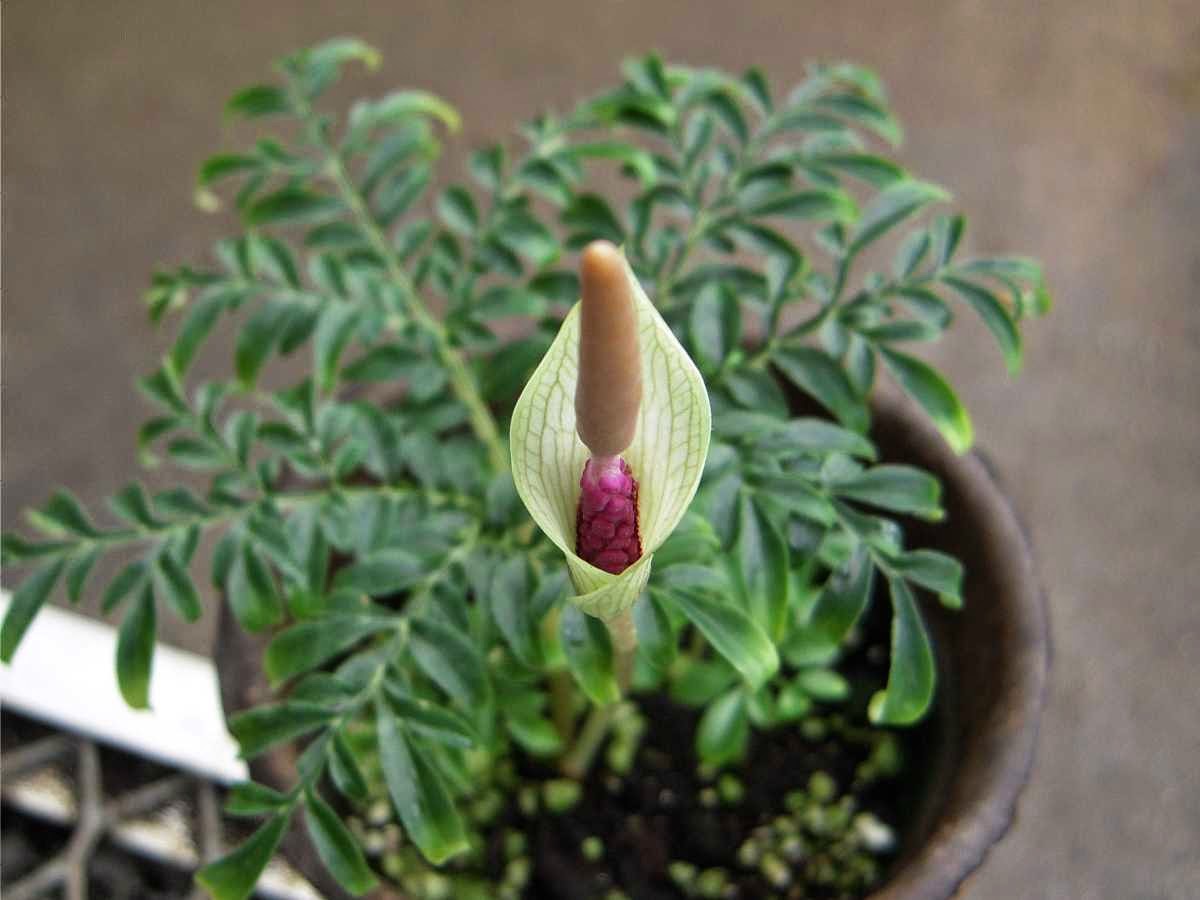
The genus Amorphophallus is known for producing some of the largest, stinkiest inflorescences in the botanical world, so A. ongsakulii comes as something of a surprise when it sends up a thumb-sized spathe and spadix, from a plant with leaves just a few inches tall. The flowers have faint spicy sweet smell.


Amorphophallus ongsakulii's natural habitat is the understory of tropical rain forest in Laos. It was only described in 2006. For me, the plant has done quite well in a warm greenhouse with some shade, with a winter dormant period where the leafless tubers were kept potted in slightly moist soil.

Tuesday, July 2, 2013

Corpse Flower 2013


For the third summer in a row, the University of Connecticut greenhouses are going to have a flowering Amorphophallus titanum. The inflorescence has been shooting up at about 10 cm per day since it broke out of its bud scales last week, and is now 117 cm tall. The rate of growth has slowed a little bit recently and the inside of the spathe is developing some reddish color, so I suspect we'll see an open bloom in less than a week's time.

Long term readers will recall that previous Titan Arums here at UConn have had yellow spadices; this plant will be the first that I've seen in person with a purple spadix. The current inflorescence is from a different batch of seed than the previous flowerings, which were grown from seed collected in Sumatra in 1994. This one is only about 10 years old, and was started from seed produced by cross-pollinating plants from the 1990s cohort grown in California. The plant's mother actually germinated here at UConn, so the father was possibly a purple form, or our original plants were actually a mix of the purple and yellow color morphs, and it was a matter of chance that the two plants kept here at UConn happened to be the yellow form. Or possibly purple is recessive and can turn up in crosses of two yellow plants; I'm not sure how spadix color is inherited in A. titanum. In any event it will be an interesting change to have a purple-spadix plant in flower.

--
 Edited to add: This year's Corpse Flower was kind of a flop. Nine days after the photo above, the spathe did pull back a bit and there was some odor, but it never really fully opened. Possibly, this young plant was still too small to properly sustain a bloom. The other mature plant of A. titanum at UConn is sending up a leaf, though, and I hope that it has a nice long growing period to bulk up its tuber and put on a proper flowering event in 2015 or so.

Monday, June 18, 2012

June 16, 2012 Corpse Flower


Here's a photo of the inflorescence at its peak of beauty around 7:00 PM on Saturday. It didn't have very much of an odor at the time, but the smell intensified later at night. The bloom has deteriorated more slowly than past blooms from the other plant, and it still looks pretty decent two days later. I wonder if there are genetic differences; the current plant (#3) has so far produced smaller inflorescences with a redder spathe that opens more widely and stays more open after the first night.

Friday, June 15, 2012

Corpse Flower Time Again


There will be another Amorphophallus titanum (Corpse Flower/Titan Arum) flowering event here at the University of Connecticut. This one caught us a bit more by surprise than usual, since it's coming from our tuber #3, which flowered once back in June 2007, but has done nothing but produce foliage since then.

The inflorescence doesn't seem like it will be especially gigantic, even after that long wait (it's at 4 feet tall and slowing down its growth now). Plant #3 produced a more colorful, more widely flared spathe than our other mature Titan Arum the last time it bloomed, though. I'll predict that it will open for the summer solstice, June 20, but keep a close eye on the UConn greenhouse webpage if you're hoping to smell it in person.

--
Edited to add: It looks like tonight is the big night: June 16,  just like the Corpse Flower last year. The greenhouse will be open at least until 11 PM, if anyone wants to come see it. I'll be there earlier in the evening. 

Thursday, June 16, 2011

Titan Arum in Full Bloom


The Corpse Flower is fully open and producing waves of cabbage-y, fishy odor right now, near 11:00 PM. These photos are from just before sunset, when the lighting was better, and the smell was potent but not quite as overpowering as it is at the moment. The weather has been pretty warm lately, and I think that has encouraged a strong flowering event this time, even if the inflorescence is a little on the short side (~5 feet). The spathe is further reflexed than in previous blooms, and the colors seem a bit brighter.

Titan Arum Bloom - June 16, 2011

3:00 PM

I just checked the Amorphophallus titanum plant, and the spathe had completely pulled away from the spadix in the two hours since I last looked at it. Tonight will be the night! I would expect it to be fully open by 8:00-10:00, and at the peak of fragrance around 12:00. By tomorrow morning it will be partially closed up, and not nearly as smelly.

The greenhouse will be open until late (1:00 AM), and then open again bright and early tomorrow at our usual time.

Wednesday, June 15, 2011

Corpse Flower: Reloaded


One of the Amorphophallus titanum plants at the UConn greenhouses is preparing to flower again. This is the Titan Arum or Corpse Flower, or what visitors tend to ask about as "that big stinky plant." The last time we had a bloom was in 2008, and I did a fair amount of blogging about it, which I won't try to repeat, though there are some points worth noting.

The individual Titan Arum in question is UConn's plant #5, which was the first of its kind to bloom in New England, back in 2004, and which bloomed again in 2007. Strangely, the plant bloomed again in 2008, without first going through the normal period of vegetative growth. It had foliage over most of the past 3 years, and seems to be back on a proper growth cycle now: dormancy--leaf--dormancy--flowering--dormancy--leaf--etc.


As with the previous three inflorescences on Titan #5, the petal-like spathe is right-handed (i.e., it wraps around itself towards the viewer's right). Left-handed inflorescences are also possible with this species, from what I've seen in photos.


The frilly edge of the spathe is starting to look a little loose, and its interior has changed from greenish to purple-black over the past week or so, so the opening of the bloom is getting close. The growth of the spadix (central poke-y bit) has slowed down to about 3-4 cm per day, which is another indication that the inflorescence is nearly mature. I predicted a couple of weeks ago that the big stink would be on June 20th, and I'll stand by that guess for now, but it could easily be tomorrow. The exact day is difficult to judge, but on that day we'll know by mid-afternoon. There will be announcements on the greenhouse website as soon as we know, so you can rush to campus. The flowers last for only a day or two, and are really only in peak condition for a few hours the night they open.


Other distractions in the Asian tropical room include fruit on the banana plant (Musa, unknown seedless cultivar). I've eaten fruits from this plant before, and they seem more or less identical to the usual supermarket Cavendish.

Monday, February 14, 2011

Don't Taste the Rainbow


Amorphophallus bulbifer is ripening a lot of fruit this year, at the UConn EEB greenhouses. In spite of appearances, and the fact that birds or some other animal disperser probably eats them, it would probably be a bad idea for a person to sample these berries. Amorphophallus is an aroid (family Araceae), a group known for being toxic to humans. In many aroids, all parts of the plant contain microscopic calcium oxalate crystals, which irritate the lining of the mouth and throat, causing intense pain and swelling that can be life-threatening if the airway becomes constricted. In some aroids and for some people, the crystals can even cause pain and rashes on the skin of hands exposed to sap from cut plant parts.

Tuesday, July 22, 2008

Amorphophallus Postscript, July 22


Two weeks after flowering, the Titan Arum is not looking so titanic any more. Actually, the stem that supported the inflorescence is still green and solid, even if the rest has collapsed. If the female florets had been pollinated and fruit was set, that stem would stick around for months, with a developing cluster of berries on top. Since we didn't try to do any pollinating, I expect everything apart from the underground corm to deteriorate in short order.

Check out the newly expanded leaf on the young A. titanum plant to the right of the former bloom. This was that skinny shoot that was poking up to the left of the bloom in many of the earlier photos.

Saturday, July 12, 2008

Amorphophallus Postscript, July 12

[Double entendre redacted]

Today was apparently the day for the spadix to lose turgor. That's just four days after opening, and two days after the pollen was shed. Corpse Flowers deteriorate rapidly after they open, which is sort of a shame, since word about a bloom usually gets out to the general public only when it actually opens, and so by the time many people get around to visiting, the inflorescence is already in poor shape. For instance, the biggest crowds came to see this bloom on Wednesday, in the late morning and afternoon, by which time the spathe was pretty well closed up. The short duration of the flowering period does add to the mystique of the Titan Arum, I suppose.

Thursday, July 10, 2008

Corpse Flower Finale

This year's Titan Arum is pretty much done. The spathe is starting to wither, and the spadix is pock-marked with the small pits and bumps that develop when the bloom is spent. Since the inflorescence was not pollinated, the whole aboveground structure will wither away within a few weeks, leaving a tuber that will stay dormant below the soil surface for a couple of months to a year, before sending up a leaf. If we had acquired pollen from another Corpse Flower and applied it to the female florets on the first night, a cluster of red berries containing seeds would have developed.

Just visible on the lower left side of the spathe in the photo above is a hole I cut into the side of the structure, to expose the male a female florets at the base of the spadix for visitors to see. Here's what the interior looked like yesterday afternoon (the day after opening):
The yellow bumps on top are the male florets, and the reddish flask-shaped structures below are the female florets. Pollen hasn't been shed yet, and the females are receptive on the first night, so that self-pollination is unlikely. And that's really the whole point of the giant, stinky flower: it draws in pollinators from a wide area, and some of the insects bring in pollen from other Corpse Flowers, so that the plant can produce seed that isn't inbred.

Today (two days after opening), the same flowers look like the image below:
The stringy, powdery stuff coming from the male flowers is the pollen. I've heard that in the wild, insects tend to get trapped inside of the inflorescence early on, but have an easier time escaping when the bloom starts to wilt, after the pollen has been shed. With a bit of luck, the pollen-covered sweat bees and carrion beetles will not have learned their lesson, and will be lured to another, freshly-opened Corpse Flower somewhere else in the jungle.

--
That's probably just about it for the Corpse Flower commentary here at Burger's Onion, though I may post a picture or two of the inflorescence's disintegration. Otherwise, plan on a return to the usual schedule of short articles, mostly about funny little South African desert plants, about one per month.

Wednesday, July 9, 2008

Amorphophallus Update, July 9

8:30 this morning.

The Corpse Flower is going down hill fast: the spathe is closing up, and while there is still a pretty funky smell about it, the odor is not nearly as gag-inducing as it was late last night. I stuck around until a little before 1:00 AM, at which point the visitors stopped coming. Up on the ladder, you could feel a current of steamy, fetid air coming off the top of the spadix. I couldn't actually see the evil vapors this time, but on one of the UConn flowers last year, several people reported a visible pale, steamy current drifting off the top of the spadix, around 2:00 in the morning.

We'll be open normal hours (8-4:00) today and the rest of the week. Local TV station Fox 61 had good coverage of the event last night, and NBC 30 had a crew out this morning, for a segment that will appear on their 11:00 AM news.

Tuesday, July 8, 2008

Titan Arum, 11 PM


The Corpse Flower is fully open, and the smell is easily detectable throughout the greenhouse complex, and even outside, in spite of the vents being closed. Sulfurous, overcooked cabbage notes predominate, like the facilities at a rustic campground at the end of August, but there are definite fishy undertones, unpleasantly reminiscent of canned tuna.

In some A. titanum plants, the spathe really opens wide and reflexes, but all three times that this individual has flowered the spathe has been more upright and funnel-shaped. There is quite a bit of variation in this species, even among the subset of plants in botanical gardens. The color of the spathe and the spadix can also vary quite a bit from plant to plant; for example, there are yellow spadices, as with both mature plants at UConn, and also dark purple ones, like this fellow at the U.S. Botanic Garden in Washington.

There's still a steady stream of students, faculty, families and plant enthusiasts coming through the greenhouse. Doors will be open for another hour or so, or you can stop by tomorrow morning and watch the bloom close. It's unlikely that it will open again, and by the end of the week it will probably have collapsed.

Titan Arum in bloom: part 2

Amorphophallus titanum plant #5, nearing fully open at 8:30 PM. The smell is tolerable, so far. The odor comes in waves, and sometimes it is hardly detectable. It's quite pungent at other times; enough to make you gag if you get close and inhale at the wrong time.

A view of the interior, though you can't quite see the individual male and female flowers (they're hidden under a bulge in the base of the spadix). Note the pale spot of variegation on the spadix.

UConn Biology Central Services professional; do not attempt.

Ray and Cherie C. on right. Ravi C. taking a break from the lab on left.

Connecticut people who can't make it in person, check out the TV news tonight. Fox 61 has already shot some footage, and some of the other stations are supposed to do live reports at 10:00 or 11:00.

Amorphophallus titanum in bloom tonight!

As of around 3:00 PM, the spathe started to show signs of pulling away from the spadix. Now it's official: the Corpse Flower is on for tonight. Those of you who are interested in seeing it in person have about eight hours to get to 75 N. Eagleville Rd., Storrs, Ct, 06269, U.S.A. (park in any student or faculty lot, since it's after hours, and make your way around behind the building to the greenhouses). We'll be open to the public until midnight (maybe later, but I promise nothing). Admission is free; B.Y.O. organic vapor respirator.

The greenhouse will be open normal hours tomorrow (8:00-4:00), but you will need to get here tonight if you want the full effect. The photograph here is current: it's early in the process of opening now, and there isn't much smell yet. It will probably be as open as it is going to get around midnight. Any time after 9:00 or 10:00 PM, and you will see the inflorescence in fine form, and be able to inhale as much of the perfume as you can stomach.

Amorphophallus Update, July 8

70.5 inches (179 cm) tall, 1.5 inches taller than yesterday.

Something I hadn't really thought about, until a visitor to the greenhouse during the 2004 Corpse Flower event pointed it out, is that the inflorescences of Amorphophallus are asymmetrical, and can be either right or left handed. That is to say, the spathe wraps around the axis of the bloom, and at the seam either overlaps itself towards the right side (viewer's right, as seen in this photo), or overlaps itself towards the left side. All of the Corpse Flower blooms at UConn (four of them, from two individuals) have been right handed, but left handed blooms do occur, as well. For example, the Smith College 2005 inflorescence and this one at Kew were left handed.

Inspection of the Amorphophallus bulbifer flowers that I posted a photo of last week shows one right handed and one left handed plant in the same pot. These inflorescences are borne on separate corms, but the corms are almost certainly clones of each other, and genetically identical (A. bulbifer reproduces prolifically from offsets, and bulbils that grow from the leaves). So it is likely that handedness is not determined genetically, for at least some Amorphophallus species. I wonder if plants can switch back and forth from year to year? In any event, handedness in Amorphophallus inflorescences seems to be a morphological oddity of little or no biological significance; development proceeds either one way or the other, and there's no functional difference in the end.

Some other instances of handedness in asymmetrical flowers are important for pollination biology. For example, in enantiostylous (Amorphophallus is "enantiospathous" ^_^) flowers, handedness differences probably function to prevent self pollination and encourage outcrossing.

Monday, July 7, 2008

Amorphophallus Update, July 7

69 inches (175 cm) tall, one inch taller than yesterday.

Looks like there won't be any further action from the Corpse Flower today, so my predicted date for the big event is no good. It could be any day now, though, so watch this space.

One of this plant's siblings that I mentioned in an earlier post, the corm that went to Smith College, is going to flower this summer. Check out their web page; they even have a webcam set up.

Sunday, July 6, 2008

Amorphophallus Update, July 6

68 inches (173 cm), 1 inch taller than yesterday.

You would think that you'd need access to an institutional-scale tropical greenhouse to raise your own Amorphophallus titanum to flowering. You'd probably be right. Seedlings or small plants from tissue culture are not all that hard to come by, and seem to go for about $50 to $100. The Huntington has had them for sale in the past, for example, and caveat emptors can usually scare up some offers on EBay (OMG Ultra Rair!!11! HUGE bulbz!). But, getting a mail order seedling up to mature size is not a trivial matter. I've known a number of enthusiastic windowsill growers and hobby greenhouse owners who have tried raising their own Titan, but have yet to hear of any big stinky blooms in someone's living room. One of the smallest facilities that I'm aware of that has succeeded is just the next town over from me in Willimantic, Ct, at Eastern Connecticut State University, where Prof. Ross Koning maintains a modestly-sized hoop house style greenhouse. Fevzi Zeren of New Jersey seems to have succeeded in coaxing a flower from a specimen grown under lights in a basement (one assumes a big basement, and the sort of light setup that earns you periodic visits from the constabulary), though he apparently started with a nearly mature corm.

Corpse Flowers aren't too difficult to please, given a warm, humid, brightly-lit space of sufficient size. Space is usually going to be the limiting factor for a plant with individual leaves 15 feet across and more than one story tall. Other than that, we use a rich, well-drained soilless potting mix, with a bit of lime added, and feed fairly heavily with human blood a balanced water-soluble fertilizer. Ideally, temperatures shouldn't drop below 65 F (18 C), and humidity should stay above 50-60%, though I know for sure that conditions become less tropical than that on a regular basis here at the somewhat antiquated UConn biology greenhouses. The soil should be kept evenly moist at all times, even when the corm is dormant, and the pot should be as big as is practical (the pot for the plant at UConn is cramped, but it's the largest size that can be moved through our doors if need be). The plants need bright light, but leaves can scorch in direct, unfiltered sun. The growth of the plants seems to be only very loosely tied to the seasons: they can have leaves and be actively growing at any time of the year. At least in botanical gardens in temperate climates, though, there seems to be a strong tendency for flowers to bloom in early summer.

Saturday, July 5, 2008

Amorphophallus Update, July 5

Titan Arum at 67 inches (170 cm) tall, two inches taller than yesterday. UConn EEB greenhouse manager Clint Morse for scale.

This individual plant started life as a seed in 1994, from a batch of seed that was collected in the wild in Sumatra by the late James R. Symon, and distributed to various botanical gardens. UConn originally had eight plants [see correction by Clint Morse in the comments], but given space limitations, and the fact that the leaves of Amorphophallus titanum get to be 15 or 20 feet across, all but two plants got donated to other universities (UC Santa Barbara, Washington State U. Pullman, Wellesley, Smith, Duke and Harvard all received UConn Corpse Flowers).

Plant #5, the one still here at UConn about to flower again, first bloomed in July of 2004, at not quite ten years of age, which seems to be about the average time from seed to maturity for this species under glass. Plant #5 flowered again in May 2007, and our other Corpse Flower from 1994 (#3, which has always been a bit of a runt), first flowered in June 2007. Number 3 is the plant with the leaf that's lurking in the background of the photos of the bud, though you can't see it very well in today's image; it's behaving properly and sending up foliage in between blooms. I'd expect #3 to flower again in early 2010. I have no idea when #5 is going to bloom next, after two consecutive flowers.