Thursday, December 6, 2012
Discocactus Advertises
Discocactus placentiformis is a small globular cactus from Brazil that flowers on warm summer nights. While open, the flowers produce a delightful honeysuckle fragrance. In common with most (all?) other nocturnal cacti, Discocactus flowers last only a single night, and rapidly deteriorate and collapse into mush the next morning. If pollinated, the flowers are followed by white, balloon-like fruits containing a few black seeds.
This particular form of Discocactus placentiformis was formerly known as D. crystallophilus, because in the wild in Brazil it grows only on open ground covered with crystalline pieces of quartz. Like all members of its genus, D. placentiformis is uncommon and highly threatened in the wild by collection and development. Under glass, the plants aren't difficult, but appreciate milder winter temperatures and more generous summer watering than most of the other genera of compact cacti.
Thursday, October 25, 2012
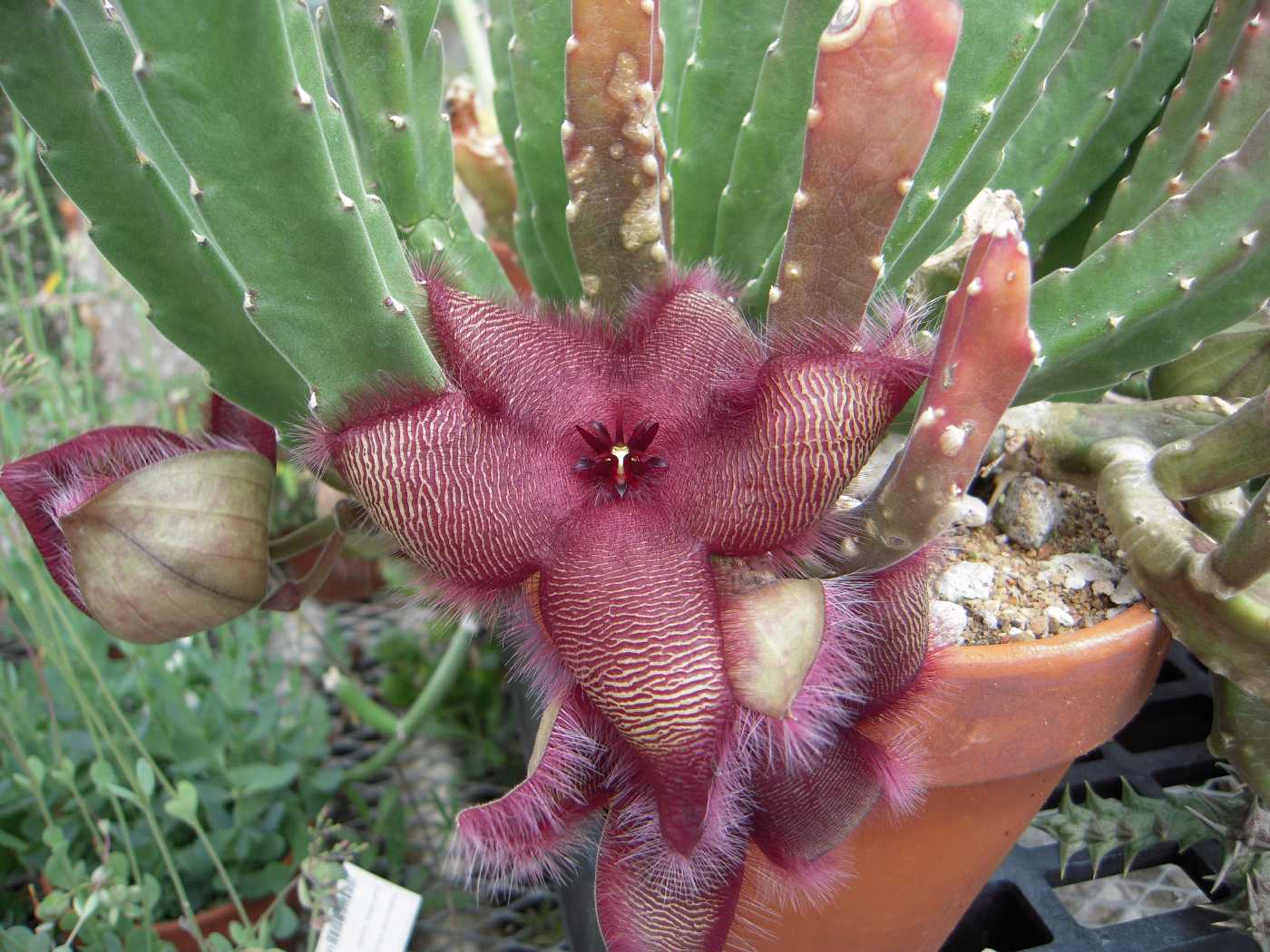
Starfish Flowers
The flowering season for most Stapelia species is summer
and early autumn, and the plants are by this time entering a period of
winter torpor. Back when the weather was warmer, though, I had some nice
blooms from these African desert relatives of the roadside wildflower
milkweed.
Stapelia grandiflora has impressive flowers, the size of
teacups, that are both colored and scented to attract pollinators such
as carrion flies. In the greenhouse, I usually realize that the flowers
have opened by the smell alone, and only after checking under the
benches and not finding any actual dead squirrels.
Stapelia
flavopurpurea, on the other hand, has small but very cheerful-looking
flowers for a stapeliad. The flower colors of different individuals of
S. flavopurpurea are remarkably diverse and can include various
combinations of violet, red, white, orange and chartreuse. It must be
pollinated by something other than the usual carrion insects, because
its fragrance is pleasant and sweet.
| Stapelia grandiflora |
| Stapelia flavopurpurea |
Sunday, October 14, 2012
Autumn Sugar Maple
The fall colors are probably about as good as they're going to get this weekend, in northeastern Connecticut. As usually seems to happen, we've had a stretch of grey, stormy weather as the leaves have been changing, which dulls the colors and knocks the leaves down early, but there have been some nice displays and occasional dry afternoons on which to enjoy them. This is a fantastic open-grown sugar maple at the top of the hill in Storrs Cemetery, which is looking like it would be very productive to tap in the spring. Sugaring season is only four months away!
Monday, October 8, 2012
Bee Season Wrap-up
Honeybee in the field gathering autumn pollen and nectar from goldenrod.
The bees are in the middle of their final burst of autumn activity, frantically storing the honey that they'll eat to keep warm all winter. In recent weeks, if the weather has been halfway decent, they've been out in the local fields, swamps and roadside clearings working various asters and goldenrods. I've also been feeding them sugar syrup, just to be certain they have enough stores to get through the cold weather. They're not going to have enough honey surplus for me to swipe any for my own use this year, but that's not unexpected, as they were starting their colonies from scratch, without any wax combs or food. According to the local beekeepers, it was a fairly mediocre year for bees in any event.
Inspection time in the apiary.
Nevertheless, the girls seem to have done pretty well in their first summer. By June, the three packages I started out with had built up to healthy colonies, and two were building queen cells, making new queens probably in preparation for swarming, where the old queen leaves to found a new colony. I was able to forestall swarming by splitting off some frames of brood with queen cells to start two new colonies.
Queen bee (at center) laying eggs.
Above is the new queen raised by one of the splits from June, after she had flown out to mate and returned to start raising more bees. This particular queen seemed to do OK at first, but then produced a fairly spotty brood pattern (missing a lot of cells when laying eggs on a comb), and I suspect that after a couple of weeks the bees gacked her and raised a replacement in a process called supersedure. One of the original colonies also seems to have undertaken a supersedure midsummer, so there was a fair amount of bee drama. They seem to have sorted everything out now, though.
Northern-raised queen from Anarchy Apiaries.
The apiary, now with five colonies, is in good shape to make it over the winter. All of the hives have quite a few heavy frames of honey. Three of them are from hardy northern stock from an apiarist in upstate New York who breeds for productive, disease and mite-resistant bees. The other two colonies were from generic southern-raised Italian bees, but they both raised new queens over the summer and the mixed colors and patterns of their offspring indicate that they probably bred with some of the northern drones. I'm feeling pretty confident going into the cold season, and am excited to see what has survived come skunk cabbage season (the earliest pollen source) during thaws in late February.
Some of the dark northern bees coming and going from the hive.
Tuesday, September 25, 2012
Tropical Succulents Talk
Myrmecodia platytyrea ssp. antoinii, an epiphyte from Southeast Asia with a symbiotic relationship with ants.
At next month's meeting of the Connecticut Cactus and Succulent Society, I'll be giving at talk about "Tropical Succulents." I'll be covering plants that grow in dry microhabitats in otherwise moist tropical forests, which sometimes have well-developed water storage tissues. Most of these rainforest succulents are epiphytes that grow without soil, clinging to branches high in the treetops. I'll have examples of myrmecophytes (ant-house plants) like Hydnophytum and Myrmecodia, orchids, jungle cacti like Rhipsalis and Selenicereus wittii, some unusual peperomias and hoyas, and others.
The meeting will be at Lauray of Salisbury, which will have a wide array of interesting succulents, begonias and orchids on sale. The trip through the Litchfield hills to Lauray should be nice in early October, too; I'd expect the fall foliage to be near its peak.
Subscribe to:
Posts (Atom)