Tuesday, June 2, 2015

Tillandsia usneioides Flowering


Tillandsia usneoides was in bloom in the UConn greenhouses the other week. The flowers are minute and greenish and easy to overlook, but do emit a slight sweet smell. "Spanish Moss" is indeed not a moss (nor is it from Spain), but a flowering plant in the pineapple family, the Bromeliaceae.

Greenhouse flowering of T. usneoides is unreliable; looking back, I don't see any records of Spanish Moss in flower at UConn since 2004. Intriguingly, the blooms this spring all seemed to be on the clumps of T. usneoides that I had left outside for a portion of last winter in an impromptu hardiness trial. The plants grow perfectly well, vegetatively, when kept in a tropical greenhouse year round, but it is possible that a cold vernalization period triggers flowering. I can't be sure that cold was responsible, though, since a number of other factors were different with the outdoor Spanish Moss. It spent the entire summer of 2014 outside, which means it received rain water rather than tap water, and probably less water and nutrients overall than the non-flowering greenhouse material. Maybe I'll try keeping some plants refrigerated next winter, and see if a cold period alone encourages blooming.

Friday, May 22, 2015

Jaboticaba


Myrciaria cauliflora fruits, or Jaboticaba.
 Myrciaria cauliflora (alternatively Plinia cauliflora; family Myrtaceae) is a small tropical tree with edible fruits, native to Brazil. Its species name is derived from the term "cauliflory," which describes trees which produce their flowers and fruits along their trunk and large branches, as opposed to at the ends of younger shoots. Cauliflory is mostly seen in tropical trees, although what function it might serve seems to be debatable. Possibly, flowers along trunks are more visible to pollinators (or fruits more accessible to animal dispersers) than they would be in the dense leafy canopy of the rainforest. There are no native cauliflorous trees in my area, but a little further south one shrub, the Redbud (Cercis canadensis), shows this condition to some extent.

Myrciaria in the UConn greenhouses, in about a 20 inch pot.
 Jaboticaba (sometimes spelled Jabuticaba) fruits are pretty tasty, with sweet, grape-flavored white pulp inside of rubbery, nearly black skins. The skins are a little bit tough, but also edible, with a slightly acrid flavor reminiscent of walnuts. In the greenhouse the flowers of Myrciaria self-pollinate, and set abundant fruit in spring without any special attention. 
 

Tuesday, May 12, 2015

Spring at Last!


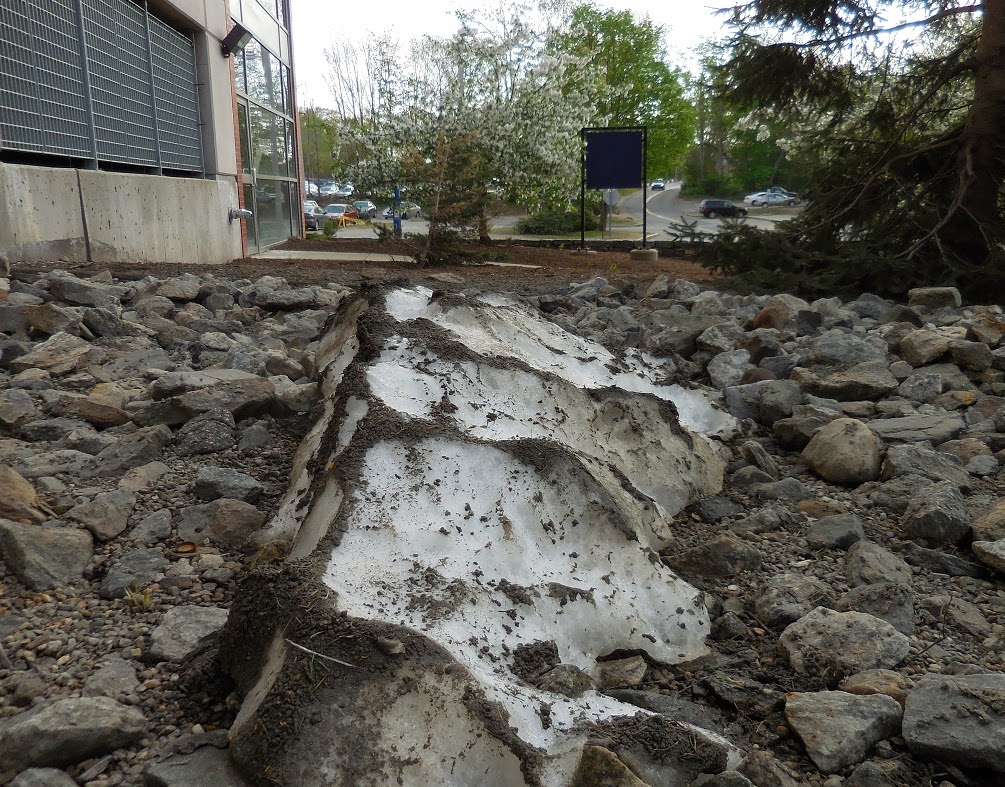
The last of the snow is finally gone, after a consistently cold and fairly stormy period from January into April. The ice sheet remnant in the photo was caught, about to disappear, on May 11. The snow was pretty much gone everywhere else a month ago, to be sure; this spot is on the north side of a parking garage on the UConn campus where a huge pile of snow gets dumped from cleared lots. Ice always lingers there for longer than it does elsewhere, but it's pretty unusual for it to last into May.


The cherry blossoms were out the other week, and this week the apples are in full bloom. The weather has actually been very warm recently (20 F above average temperatures on a few days), so the growing season is catching up rapidly. I'd say that the plants are only a week or so behind schedule at this point, versus a month late back in the maple sugaring season.


The bees are really taking off at this point, although they were delayed for so long that I don't think colony sizes will be large enough to really take advantage of the earlier phases of the spring nectar flow. The weather has also been unusually dry lately, which won't help nectar production, and could lead to a pretty poor year for honey in Connecticut.


The other day in Glastonbury, Ct, I ran across some nice patches of Polygala paucifolia (Fringed Polygala), on somewhat open slopes in pine/oak woods. This plant seems to be fairly rare in this area and I don't know of many localities where it occurs. The color of the flowers is unlike anything else that blooms on the forest floor, and the plants stand out from quite a distance.

Friday, April 10, 2015

32nd Connecticut Cactus and Succulent Show


 The Connecticut Cactus and Succulent Society's annual show and sale is always a fun time, and is impressive as specialist plant shows go, especially considering that it is held by a club in a small state in a part of the country that is very challenging, climatically speaking, for growers of desert plants. And I don't just say this as the president of the CCSS: if you come to Naugatuck Valley Community College for the cactus show this weekend, I can pretty much guarantee that you will see some little gems of the succulent plant world that have never been exhibited at either the elite flower and garden shows of the east coast that have been running since Victorian times, or the dedicated C&S shows run by huge western clubs. I'm sometimes not exactly sure myself how it all comes together, but by tomorrow morning there is going to be another fantastic display of exotic horticulture, incongruously placed in the drab grey of central Connecticut in early April.

Part of the vendor area, getting set up Friday evening.
Some caudiciform plants waiting to get staged in the show area, from Chris Allen's collection. Chris's greenhouse had a heating failure on a particularly cold night this past winter and froze hard, but the survivors are coming back well. 

Tuesday, March 31, 2015

Mud Season '15

Crocus cultivars blooming in a warm spot; most spring bulbs are still under the snow pack.
 The weather is slowly warming up, though spring flowers are probably still a good three weeks to a month behind schedule. The bees have been out and about on quite a few sunny afternoons lately, but they're not finding much of anything to eat beyond the Domino nectar flow, as it were. The overall colony survival rate still looks like about 70%. 

A short pause in the sap flow, with the snow pack freshened up, March 28.
  Around the middle of March, the maple sugaring season really got going in earnest, again about a month late. Over the past two weeks, there has been a pretty reliable daily sap flow, and half a dozen  banner sap days when I've collected a gallon from each tap in the morning before work, then come home to find another gallon with some loss to overflow in the evening. Some of the best production has been during rainy thaws, where chilly but above freezing temps have kept the flow going 24 hours a day for several days straight.


This past week, two taps yielded a bit more than 10 gallons of sap (it's hard to tell exactly how much, since I've been skimming ice off of the sap buckets each morning). This boiled down to a quart of maple syrup, in the typical 40:1 ratio. The syrup is looking cloudy in the photo because of "sugar sand," a mineral precipitate that I will allow to settle and filter out. 


Eden the cat is very particular about not walking on snow, but with recent thaws she has been enjoying a much larger field of operations in the fenced backyard. She had been getting cabin fever, with only a couple of inches of open ground under the eaves where she could run back and forth when it was warm enough to venture outside.