Saturday, March 12, 2022

Maple Sugaring 2022


 The winter freeze-up was pretty late this year in southern New England, with the real cold holding off until January, but it was actually too cold for much sap flow for a few weeks after the traditional start of maple sugaring season on Valentine's Day, which is a rare occurrence these days. Since the beginning of March temperatures have been more seasonable, with some warm sunny days, some rain and some snow, and the sugar maples have been quite productive. Last week my lone tap produced about 12 gallons of sap, which boiled down to one quart of syrup, for a 48:1 ratio (the ideal ratio usually cited is 40:1). 

There is a big winter storm moving through today, with a bit of cold rain, snow and a lot of wind, and the next day or so will provide a good solid freeze to reset the sap flow. Next week is set to be much warmer, with barely any chances for even a light frost at night, so it is possible that the sugaring season will be coming to an end soon. If there are too many days this time of year without frost, or the temperatures get too high, the sap flow stops and the season ends. If that does happen, it will have been a rather poor maple syrup year, starting more slowly due to cold and ending a week or two earlier than usual because of early spring warmth.

Wednesday, March 9, 2022

Remembering the Nut Museum

The Benton Museum of Art at UConn, March 2022.

For just about 30 years, beginning in April 1972, Connecticut was home to perhaps the world's only museum dedicated to nuts (as in, large, usually edible seeds, with a tough outer shell usually derived from fruit tissue). The Nut Museum was the life's work of eccentric artist Elizabeth Tashjian, who operated it by herself out of the first floor of her home in Old Lyme. Ms Tashjian was hospitalized, comatose, in 2002, and her estate was liquidated on the assumption that she would never recover. That normally would have been the end of a small private museum with a one-person curatorial staff and board, but Connecticut College professor Christopher Steiner managed to acquire and preserve the Nut Museum collection, and has put on occasional public displays of the nuts, artworks and related material in the 20 years since. 

Painting by Elizabeth Tashjian, with the first line of the Nut Anthem.

 The Benton Museum at the University of Connecticut has been hosting the 50th anniversary Nut Museum revival this winter, with an extensive display of Ms Tashjian's paintings, sculpture, ceramics and nut-themed music. Botanical specimens include several Coco de Mer nuts (Lodoicea maldivica, family Arecacae), the largest seeds of any plant, which were apparently a special favorite that appeared repeatedly in her artwork. The current display also includes a re-creation of the main gallery of the Nut Museum, as it appeared at its zenith in the 1970s.

2022 reconstruction of the Nut Museum at UConn.

The Benton Nut Museum exhibit, along with associated talks and films, give a sense of the strangeness, gentle spookiness and humor of the original museum and its proprietor. One strong theme of the display is the experience of a certain generation and class of American women who were emphatically not brought up to be independent, but who nonetheless made a place for themselves in the world on their own. Another theme is the failure of society to compassionately deal with elderly people with no family and little means of support. The story of the Nut Museum ends on a hopeful note: Elizabeth Tashjian made an unexpected recovery from her medical crisis, and lived another five years at an eldercare facility where she seemed reasonably happy. Although she never returned to her house, she was grateful that the contents of the Nut Museum had been saved, and she was able to preside over several of the early post-Museum exhibits of the collection.


Elizabeth Tashjian's nut-themed masks.
 

Prof. Steiner is currently researching and writing a book about Elizabeth Tashjian and the Nut Museum. Publication sounds like it may be a couple of years off.

Anthropomorphic Horse Chestnut (Aesculus hippocastanum, family Sapindaceae) and Walnut (Juglans regia, Juglandaceae) paintings by Elizabeth Tashjian.


Friday, September 24, 2021

Growing Hartford Fern from Spores


Lygodium palmatum sporeling at five months old.

In a previous post I talked about the biology and ecology of the Hartford Fern, Lygodium palmatum, America's lone native species of climbing fern. In this post I will discuss the process of growing this rare and botanically interesting plant from spores, which turns out to be relatively quick and unproblematic, as fern propagation goes. 

Spores: Plant material of Lygodium palmatum is occasionally available from mail order nurseries, but the only regular source of spores that I am aware of is the American Fern Society's spore exchange, currently meticulously curated by Brian Aikins in Washington state. Spores could also be collected from mature plants in late autumn, if one happens to already have access to cultivated plants.

Lygodium palmatum, gametophyte (dark green) with one-leaved sporophyte emerging (light green).

Soil: Hartford Fern grows in acidic soil, so I have used a light, acidic mixture of sphagnum peat moss and perlite for starting spores. I pasteurize small batches of soil in a microwave (on high for about five minutes), which helps to prevent or at least delay contamination of spore pots by algae and moss. 

Sowing Spore: Lygodium spores are as fine as dust and must be sown on the surface of pots of soil, where they will be exposed to light. Temperate zone ferns like L. palmatum are best started in spring; no special pre-treatment, such as cold stratification, is needed. Ideally, spores should be sown thinly, so that the sporelings will have a little space between them, but this is difficult to accomplish. The soil is kept moist to wet by watering from below or with gentle misting, and the whole pot should be kept in a humid, closed environment in a plastic bag or terrarium. Bright but indirect light is best (such as in an east-facing window, or at the periphery of a grow light setup). 

Germination and Sporeling Care: Lygodium spores germinate within a month or so, giving rise to crinkly, dark-green gametophytes. Gametophytes are the haploid (only one set of chromosomes), gamete-producing phase of the plant alternation of generations. The spore sowing mix has very little nutrient content on its own, so misting several times a month with half-strength water-soluble houseplant fertilizer is needed from germination on. 

The gametophytes take several months to mature, at which point they produce sperm and eggs, fertilization takes place, and tiny, light-green leaves start to emerge from the undersides of the gametophytes. These light-green leaves are the young sporophytes, the diploid, spore-producing phase of the life cycle. In ferns, the sporophyte is the large, long-lived phase of the life cycle; what we typically think of as a fern plant. 

The sporelings can be transplanted out to individual pots when the sporophytes have one or two fully expanded leaves and are about a centimeter or two across; this will probably be in summer, about four months after sowing. Transplants should be gradually adjusted to brighter sun and lower humidity, in preparation for overwintering the young plants in a cold greenhouse or sheltered position outdoors.

Lygodium palmatum, 6 month sporeling starting to put out dissected leaves. 

Friday, August 27, 2021

Hartford Fern

Lygodium palmatum climbing on Osmundastrum frond. Windham County, Connecticut, August 13 2021.

One of the most unusual native ferns in my area is Lygodium palmatum, the Hartford Fern or American Climbing Fern. The climbing ferns are about 40 species of Lygodium, the lone genus in the family Lygodiaceae, distantly related to the curly-grass ferns (family Schizaeaceae). The climbing ferns are mostly tropical, with a few representatives in north temperate regions, including Lygodium palmatum, the sole species of climbing fern native to the US.

Lygodium palmatum with fertile and sterile leaflets, climbing on Winterberry (Ilex verticillata).

Climbing ferns are indeed vines--uniquely, I believe, among ferns--which twine around other plants in order to reach sunlight and position their spore-producing structures higher for more efficient spore dispersal. Perhaps even more peculiar than the vining habit of Lygodium, is the fact that the vines are not stems, but very long, indeterminately growing leaves (the only stem tissue in climbing ferns is the underground rhizome from which the twining leaves arise). The fronds grow from a meristem (growth point) at their tip, periodically producing new leaflets (pinnae). Some large tropical species of Lygodium have additional meristems at the base of each leaflet, which can grow out as new vining fronds, especially if the main growing point of the frond is severed. This growth form is a remarkable parallel to the organization of the entire shoot system--with shoot apical meristems, stems, leaves and axillary buds--of just about every other group of plants. 

Lygodium palmatum, fertile leaflet underside with immature sori, in August.

 Mature Hartford Ferns bear two different types of leaflets. On the lower parts of the frond there are broad, palmate (hand-shaped) sterile pinnae, which are strictly there for photosynthesis, not reproduction. The more distal parts of the frond may bear fertile pinnae, which are more branched and end in many narrow pinnules. Fertile leaflets have sori on their undersides, which are clusters of minute sporangia, the capsules that shed spores in autumn.

Lygodium palmatum patch, with Marsh Fern (Thelypteris palustris).

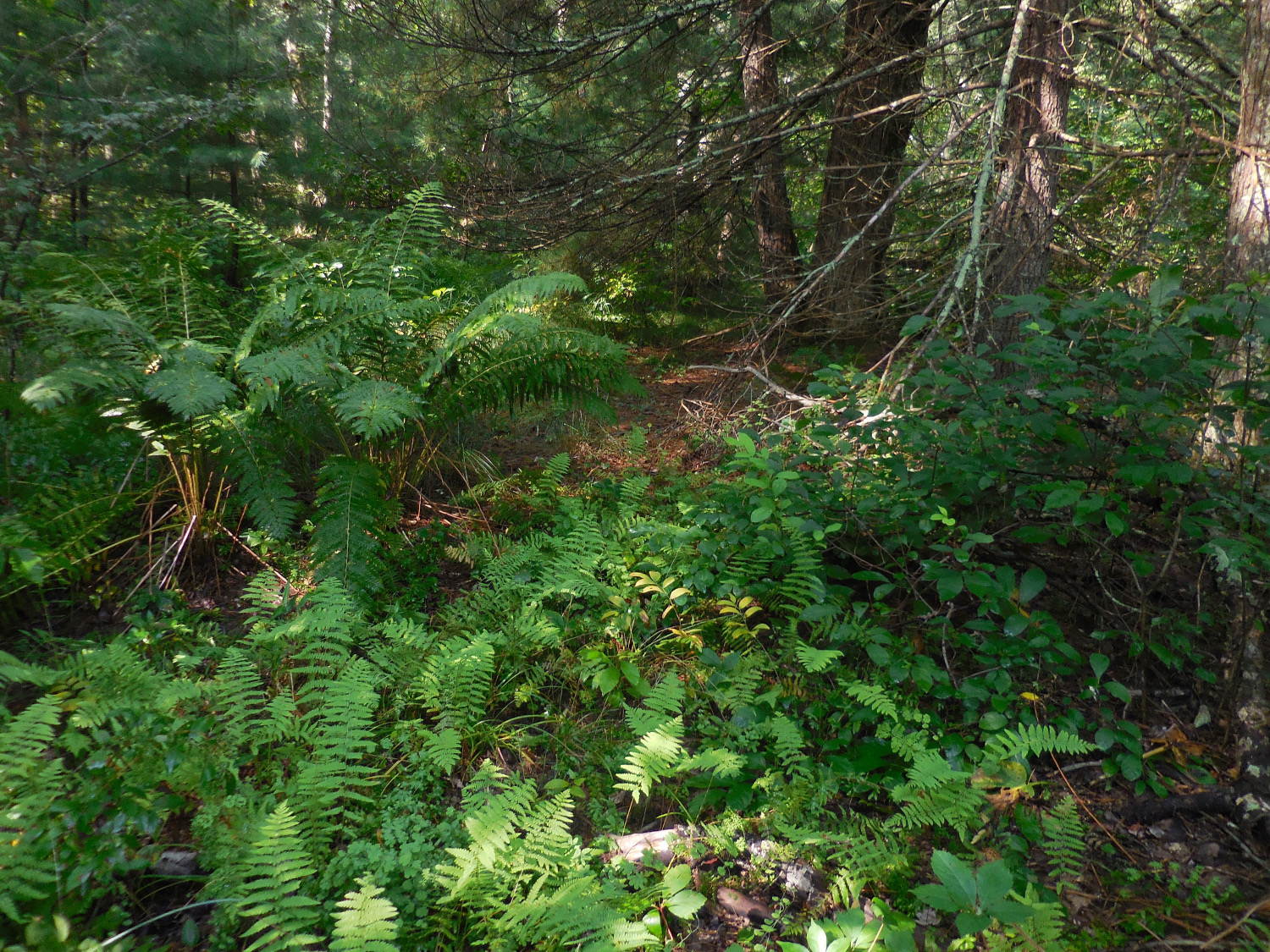
Hartford Fern is associated with wetlands with acidic soil; I have seen it in Red Maple swamp and river floodplains, generally in spots with dappled sun under a somewhat patchy tree canopy ("high shade" as wildflower gardeners say). Lygodium grows on hummocks, banks and other slightly elevated spots in wetlands, seemingly avoiding low places that would have standing water in spring. Associated plants include Cinnamon Fern (Osmundastrum cinnamomeum), Royal Fern (Osmunda regalis), Catbrier (Smilax rotundifolia) and the usual shrubs of acidic swampland such as Sweet Pepperbush (Clethra alnifolia) and Highbush Blueberry (Vaccinium corymbosum).
Lygodium palmatum habitat, Windham County, Ct.

 Red maple swamp with Cinnamon Ferns is not exactly an uncommon habitat in the Northeast; there are probably hundreds of acres of wetland that looks appropriate for Lygodium, in my town alone. But as far as I know, there are no Lygodium populations at all in my immediate area. Hartford Fern is geographically widespread, too, being native to most of the states east of the Mississippi. It's a bit of puzzle, then, just how rare our native climbing fern is; there are apparently fewer than five patches of it in all of New York state, for instance. 

Part of the reason for Hartford Fern's rarity is thought to be the collection of the fern's evergreen fronds for Christmas decorations in the nineteenth century, which led to the state of Connecticut passing legal protections for the species in 1869, the first endangered plant legislation in the United States. Land clearance for agriculture and the flooding of wetlands by widespread construction of dams for mills probably also harmed Lygodium populations in New England. It's possible that there is some non-obvious reason, as well, why most semi-open wet woodlands are not actually suitable for Lygodium, despite looking similar to the vanishingly rare spots where Hartford Fern does grow. In any event, catching sight of our native climbing fern is a special and unfortunately quite uncommon occurrence. 

--

A followup post covers propagating Hartford Fern from spores in cultivation.


Saturday, August 14, 2021

Midsummer Orchids

Platanthera psycodes, Lesser Purple Fringed Bog Orchid.

 The hazy, hot and humid period in late July in early August is generally a slow time for wildflowers in New England--the spring ephemerals are long past and the late-summer asters and goldenrods haven't started--but there are a number of native orchids that bloom during the height of summer.
 
Goodyera tesselata, Checkered Rattlesnake-Plantain, in late July in Ashford, Ct.
 
 Goodyera, the rattlesnake-plantains, is a large, almost cosmopolitan genus of terrestrial orchids, with two species extant in Connecticut (and one more probably extirpated). Goodyera tesselata is the less common of the two, a small plant with pale, checkered leaves. It favors well-drained, piney woods, and is more frequently encountered to the north of my area. Checkered Rattlesnake-Plantain  is thought to be derived from an ancient hybridization event between two other Goodyera species.
 
Goodyera pubescens, Downy Rattlesnake-Plantain, in late July in Mansfield, Ct.
 
Goodyera pubescens, or Downy Rattlesnake-Plantain, is by far the more common species in its genus in southern New England, and is one of the most frequently encountered wild orchids overall. An observant hiker can spot the green-and-silver variegated rosettes and spikes of white flowers of this charming plant, on virtually any walk through the woods in eastern Connecticut. The rosettes of leaves grow from branching underground rhizomes, and can form large colonies.

Platanthera clavellata, Small Green Wood Orchid, in late July in Mansfield, Ct.

Platanthera is the most diverse genus of orchids in New England, with about 16 species, though many of these are very rare, localized, or "historical" (locally extinct). Many species have had a hard time with development, invasive species (including earthworms and slugs), forest succession, deer overpopulation, a warming climate, and probably in some cases direct picking and digging by gardeners. One species that seems to be doing pretty well in Connecticut is P. clavellata, which is not that uncommon in acidic, swampy woods and on stream banks. It is difficult to spot out-of-flower, with a few nondescript oval leaves, and even in flower is not what you would call showy, so it is quite possible that it is even more frequent than my impressions would indicate.

Platanthera psycodes, Lesser Purple Fringed Bog Orchid, in late July in Tolland County, Ct.

Platanthera psycodes, on the other hand, is rather uncommon in my area, but beautiful and totally obvious when in flower. Flowering plants are waist-high. with lovely violet-pink petals. The flowers are not strongly scented, have long nectar spurs behind the petals, and are pollinated by butterflies. The plants pictured here were scattered along a cold, spring-fed stream, in mucky, acidic soil.