Showing posts with label orchids. Show all posts

Saturday, August 14, 2021

Midsummer Orchids

Platanthera psycodes, Lesser Purple Fringed Bog Orchid.

 The hazy, hot and humid period in late July in early August is generally a slow time for wildflowers in New England--the spring ephemerals are long past and the late-summer asters and goldenrods haven't started--but there are a number of native orchids that bloom during the height of summer.
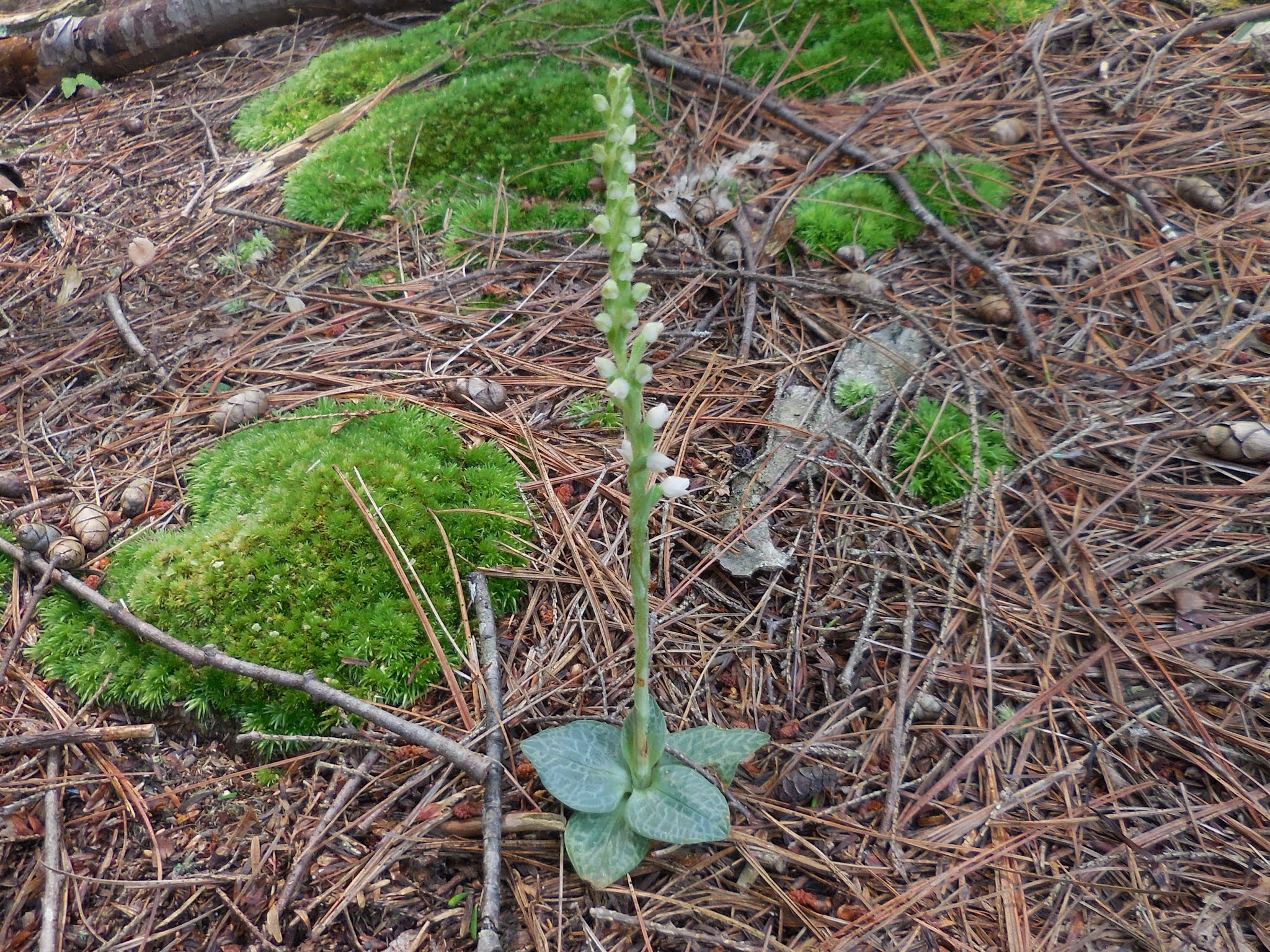
 
Goodyera tesselata, Checkered Rattlesnake-Plantain, in late July in Ashford, Ct.
 
 Goodyera, the rattlesnake-plantains, is a large, almost cosmopolitan genus of terrestrial orchids, with two species extant in Connecticut (and one more probably extirpated). Goodyera tesselata is the less common of the two, a small plant with pale, checkered leaves. It favors well-drained, piney woods, and is more frequently encountered to the north of my area. Checkered Rattlesnake-Plantain  is thought to be derived from an ancient hybridization event between two other Goodyera species.
 
Goodyera pubescens, Downy Rattlesnake-Plantain, in late July in Mansfield, Ct.
 
Goodyera pubescens, or Downy Rattlesnake-Plantain, is by far the more common species in its genus in southern New England, and is one of the most frequently encountered wild orchids overall. An observant hiker can spot the green-and-silver variegated rosettes and spikes of white flowers of this charming plant, on virtually any walk through the woods in eastern Connecticut. The rosettes of leaves grow from branching underground rhizomes, and can form large colonies.

Platanthera clavellata, Small Green Wood Orchid, in late July in Mansfield, Ct.

Platanthera is the most diverse genus of orchids in New England, with about 16 species, though many of these are very rare, localized, or "historical" (locally extinct). Many species have had a hard time with development, invasive species (including earthworms and slugs), forest succession, deer overpopulation, a warming climate, and probably in some cases direct picking and digging by gardeners. One species that seems to be doing pretty well in Connecticut is P. clavellata, which is not that uncommon in acidic, swampy woods and on stream banks. It is difficult to spot out-of-flower, with a few nondescript oval leaves, and even in flower is not what you would call showy, so it is quite possible that it is even more frequent than my impressions would indicate.

Platanthera psycodes, Lesser Purple Fringed Bog Orchid, in late July in Tolland County, Ct.

Platanthera psycodes, on the other hand, is rather uncommon in my area, but beautiful and totally obvious when in flower. Flowering plants are waist-high. with lovely violet-pink petals. The flowers are not strongly scented, have long nectar spurs behind the petals, and are pollinated by butterflies. The plants pictured here were scattered along a cold, spring-fed stream, in mucky, acidic soil.


Sunday, August 14, 2016

Albino Woodland Plants

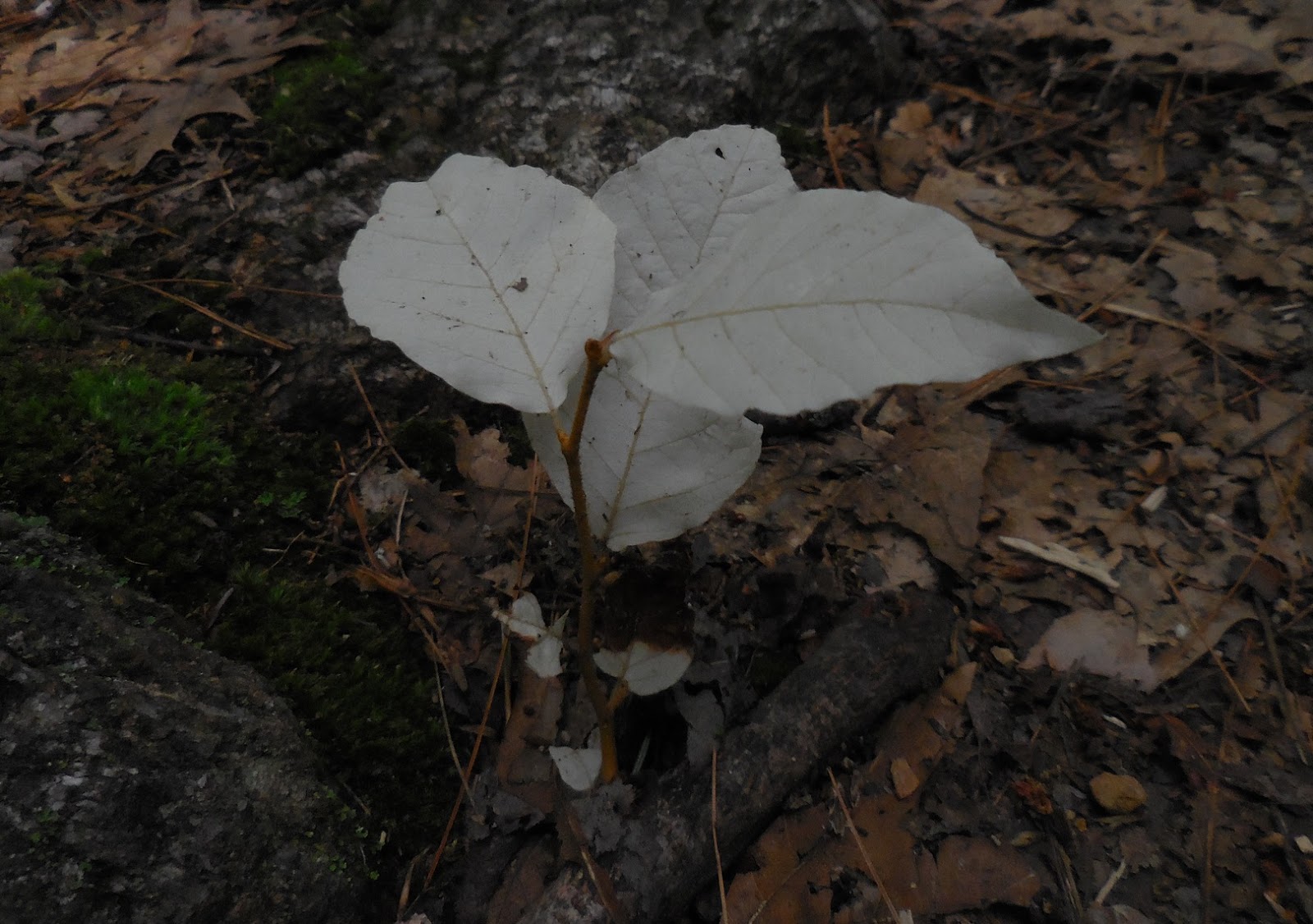
Albino Fagus grandifolia, Meredith, NH, July 2016.
Albino plants, which have lost the ability to make the green pigment chlorophyll, show up occasionally among seedlings or as abnormal growth from an established plant. This summer, I've noted a couple of photosynthetically-challenged native plants in my travels, including the American Beech (Fagus grandifolia) above. American Beeches send up root-borne shoots as a method of vegetative reproduction; in this case something went wrong with chlorophyll synthesis in part of the root system of a normal mature beech, and there were several pale shoots like this in a small area of the forest floor. The albino shoots are supported by sugars produced by the original green, photosynthetic portions of the clonal grove of trees. The albino beeches were in a pine/maple/hemlock forest near Winnesquam Lake in New Hampshire.


 Albino Cypripedium acaule, Mansfield Center, Ct, May 2016.
Back in Connecticut, I discovered an immature Pink Lady's Slipper with a completely albino leaf. This was the first time I've seen a true albino form of this woodland orchid, though apparently others have been photographed, including one that grew to flowering size. Almost all orchids have minute seed and seedlings that cannot survive on their own at first, relying on symbiotic fungal hosts from which they absorb the nutrients they need to grow. All Pink Lady's Slipper seedlings go through a subterranean phase that can last several years, when they produce no foliage at all. Presumably, an albino Cypripedium seedling can survive for an indefinite period, by relying on its parasitic relationship with fungi long after normal green plants would be making most of their own food. 

White flowered Cypripedium acaule, Mansfield Hollow.
Back around Memorial Day I revisited the white-flowered Pink Lady's Slipper that I found two years ago in Mansfield Center, Ct. It's still doing well, although I looked last year and couldn't find it; possibly it skipped a year without blooming.

Friday, June 6, 2014

White Lady's Slipper


It had been a cool, prolonged spring in Connecticut, although recent stretches of sun and warmth have allowed the local flora to catch up. The Pink Lady's Slipper orchids bloomed right about on schedule for Memorial Day and the end of May. Now, the Pitcher Plants and Mountain Laurel are in bloom, on time or even a little early.

While hiking in Mansfield Center the other week, I ran across something I hadn't seen before in person: a white Lady's Slipper. This is an albino individual of the Pink Lady's Slipper (Cypripedium acaule), not one of the other species of the genus. The plants seem to vary a fair amount in their flower coloration, but C. acaule plants without a trace of pink are pretty uncommon.


Speaking of abnormal Lady's Slippers, the photo above shows a strange one, with one of its two leaves attached midway up the pedicel (stem subtending the flower). The specific epithet of C. acaule means "stemless," and I have never seen one before or since with leaves that didn't emerge directly from the ground, from a stubby subterranean stem. Other species in the genus have leafy stems with elongated internodes between the leaves, but this condition seems to be a very rare throwback for the Pink Lady's Slipper. The plant was the sole example of this growth form in a large population growing in Pitch Pine woods in Mashpee, Massachusetts, on Cape Cod.

I'm uncertain of whether either of the odd forms of C. acaule described here have a genetic basis. It would be interesting to try to find the plants in future years and see if the flowers are consistent. I suspect that the albino coloration is caused by a mutation and will remain from year to year, but the plant with the abnormal elongated internode might have been the result of a single season's disrupted development.

Friday, January 10, 2014

Eulophia petersii

Eulophia petersii flower.
The Orchidaceae (orchid family) is the largest family of flowering plants, comprising something on the order of 25000 species. The orchids are most diverse in the tropics growing as epiphytes on the trunks and branches of trees, although even here in Connecticut we have a number of native species. Most of the epiphytic orchids are more or less succulent (unlike our native woodland and bog orchids), as an adaptation to surviving the short periods of dryness that can even afflict plants in the tropical rainforest, if they are growing attached to bark without soil.
Although they are much fewer in number of species than the tropical epiphytic orchids, there are succulent orchids that live in true desert environments. Eulophia petersii is one of the most widespread of the desert orchids, occurring over much of eastern Africa, from South Africa to Somalia. The plants grow in shallow soil over rock outcrops, or in dry sandy soil, in areas with a warm, dry climate with rain primarily in summer.
Eulophia petersii plants consist of clusters of squat, fat green stems (called pseudobulbs in orchids) that bear a small number of succulent, sharp-edged leaves. The plants are evergreen and the leaves can persist for several years, but the actual growth of the plants is highly seasonal. New pseudobulbs and foliage are produced in spring and summer, and tall racemes of flowers bloom in mid-summer. In the winter, the plants are dormant and can withstand weeks or months without water. 
Eulophia petersii plant with succulent leaves and pseudobulbs.
In cultivation, E. petersii plants are not difficult to grow in conditions similar to those favored by agaves and echeverias. It may help to use a soil that is especially coarse and free-draining, though general-purpose cactus and succulent mixes should be acceptable. In summer, a fairly generous watering and fertilizing regime produces good results, as long as the plants get plenty of sun. In winter, E. petersii should be watered lightly and infrequently and kept in a cool, sunny location. Home propagation of Eulophia is probably only practical by dividing older clusters of pseudobulbs. Cultivated plants do set seed if pollinated, but as with other orchids the seeds are minute and require exacting conditions, possibly including the presence of symbiotic fungi, in order to germinate and grow. I've never had any luck trying to start the seeds by sprinkling them in the soil around the parent plants.

Saturday, June 4, 2011

Memorial Day Bog Walk

Iris versicolor, Northern Blue Flag.

Memorial Day is usually a good time to catch some of the more impressive native wildflowers here in New England. This year, I checked out an unnamed bog at an undisclosed location in Willington, Connecticut. Walking to the bog there were some richer swampy spots where the wild geraniums and blue flag iris were in full bloom.

Cyprepedium acuale, Pink Lady-slipper (this photo actually from Mansfield Hollow State Park).

Closer to the bog, the vegetation changed to indicate the presence of nutrient-poor, acidic, bog-friendly soil. Sugar Maples and White Ash were replaced by pines and oaks as the dominant trees, and the understory started to include Pink Lady-slipper orchids in flower, and one little patch of Epigea repens (Trailing Arbutus).

Ledum groenlandicum, Labrador Tea, in the Willington bog.

After a short but slightly hairy time navigating the inevitable marginal ring of open water and peaty muck at the edge, I emerged into a sunny sphagnum bog. This is a floating bog, though the open parts are mostly dense enough with moss and scrub to provide secure footing. It is still irresistible to bounce up and down a little bit, and watch the dwarf trees within a 20 foot radius sway back and forth.

Ledum, or Labrador Tea, was in full bloom. Labrador Tea is mainly a boreal plant, though it hangs on here and there in bogs in the more temperate parts of the eastern US. The leaves have a distinctive brown fuzzy underside, and can in fact be used to make a somewhat wintergreen-tasting tea. The Willington bog is the only local spot I know of where it grows, and I had never caught it in flower before.

Sarracenia purpurea var. purpurea, the Purple Pitcher Plant.

The pitcher plant flowers weren't quite open yet for the most part. There aren't a huge number of Sarracenia in this bog, though the population seems pretty stable. There aren't any sundews in this bog at all, which is strange; it looks perfect for Round-leaved Sundews at least, and the other area bogs have one or both of the local Drosera species. It's doubly odd because there is an area of seeps not half a mile away where both sundews grow in large numbers.

Picea mariana, Black Spruce, about 1 m tall, with female cones.

Another interesting feature of this bog is a large population of Black Spruce trees, stunted into natural bonsai. Black Spruce, like Ledum, is primarily a boreal plant, which persists in boggy spots and the occasional cold mountain slope in southern New England. There is a tiny mistletoe, Arceuthobium pusillum, that grows on the spruce trees in the Willington bog, but I couldn't find it this time. I seem to recall seeing it once before, years ago when I first visited this location, in later summer, but that time the mistletoe was pointed out by the late Les Mehrhoff, who knew the local flora twice as well as anyone else. It is a shame that Les won't be guiding any more bog walks.

Wednesday, December 9, 2009

Epiphyte Tree at UConn Greenhouses


One of the big events this past fall here at the University of Connecticut greenhouses has been the completion of an epiphyte tree in the entryway, which had previously been somewhat cramped and lacking in focus. The new entryway provides space for tours to assemble, and a point of interest to draw visitors in.

Epiphytes are plants that live on the surface of other plants, using their hosts for support but not acting as parasites. About the only epiphytes that occur naturally here in Connecticut are tiny mosses and liverworts that grow on tree trunks, but in tropical climates trees may be festooned with diverse communities of orchids, bromeliads, ferns and others.

The UConn epiphyte tree was put together over the summer, with many hours of volunteer help from the Connecticut Orchid Society. It is constructed around a skeleton of steel pipes clamped together into a hexagonal trunk, with additional pipes jutting out above head level to create branches. The trunk is covered with panels of expanded metal, which do a good job of rounding out the angular underlying structure. All of the basic structural materials were recycled from old bench parts from the greenhouses.

Clint Morse and members of the C.O.S. assemble the epiphyte tree's internal skeleton.

Probably the most time-consuming part of the construction of the epiphyte tree was covering it with bark. We used natural cork oak bark, which is harvested—sustainably, without killing the trees—in the western Mediterranean region. The C.O.S. and greenhouse manager Clint Morse laboriously fit pieces of bark together, sometimes cutting them to fit or softening them with steam in a large autoclave to mold them into the right shape, then wired them in place. Gaps were filled in with slivers of bark glued in place, or clumps of coconut fiber. The branches of the epiphyte tree were covered with special ordered bark tubes (taken whole from smaller cork oak trunks).

Some of the initial plantings were done as the bark was being fit into place, using epiphytes already established on pieces of cork. More plants were wired or glued into place later, and these should anchor themselves and spread with time. We’re still working on fine-tuning the tree and its plantings, but stop in and check it out if you’re in the area!

Monday, May 25, 2009

Lady's Slippers at Mansfield Hollow


Memorial Day is usually flowering time for Cypripedium acaule (Pink Lady's Slipper), a native orchid that occurs here and there in northeastern Connecticut. Last weekend, I checked out a few local populations that I knew from previous years, and didn't see much in the way of flowers or buds, so I figured it was going to be a bad year for Lady's Slippers. However, poking around Mansfield Hollow State Park today, I ran across some really impressive stands of this somewhat uncommon wildflower. There was a little evidence of damage from deer and two-legged vermin (one plant pulled up and left by a trail), but also many dozens of plants at the peak of bloom.

The Mansfield Hollow and Mansfield Center region is underlain by thick layers of rough, nutrient-poor sand and gravel left over from the glaciers. The trees are mostly White Pine and various oaks, and there are blasted heaths of bare sand where vegetation has never managed to recolonize old roads or gravel pits. There's a neat overview of the local geology here. However, areas with exceptionally poor soil like this are always home to interesting plants.

Dry, acidic woods like these are the typical home of Cypripedium acaule. The plants seem to favor somewhat open sites in the forest, and patches of Lady's Slippers tend to come and go over the years as old sites get overgrown and new gaps open up. The long, toothy leaves in the background are an American Chestnut sprout, another frequent component of the flora in this type of habitat.


In the harshest spots where the orchids hang on, they're shorter than the plants deeper in the woods. This was a population under some stunted pines near an open gravel slope; the canopy was thin enough and the soil dry and poor enough that there were also patches of Reindeer Lichen (Cladonia rangiferina).

Pink Lady's Slipper is protected in Connecticut (doubly so in state parks), so visitors should tread lightly around the plants, and not pick or dig them under any circumstances. In any event, the plants need very specialized conditions to grow and are nearly impossible to transplant (gardeners should not take that as challenge! Seriously, it is cruel and wrong to swipe these plants from the wild), and are best enjoyed in situ.