Showing posts with label Dionaea. Show all posts

Sunday, September 30, 2018

New England Carnivorous Plant Show 2018

A carnivorous plant fairy garden. It's kind of implied that the local fairies aren't the brightest bulbs on the tree.  
Earlier this month, the New England Carnivorous Plant Society held its annual show at Tower Hill Botanic Garden near Worcester, Mass. There were nearly 2000 visitors for the weekend, which is a little down from recent years, but still impressive for a specialist plant show.

Darlingtonia californica.
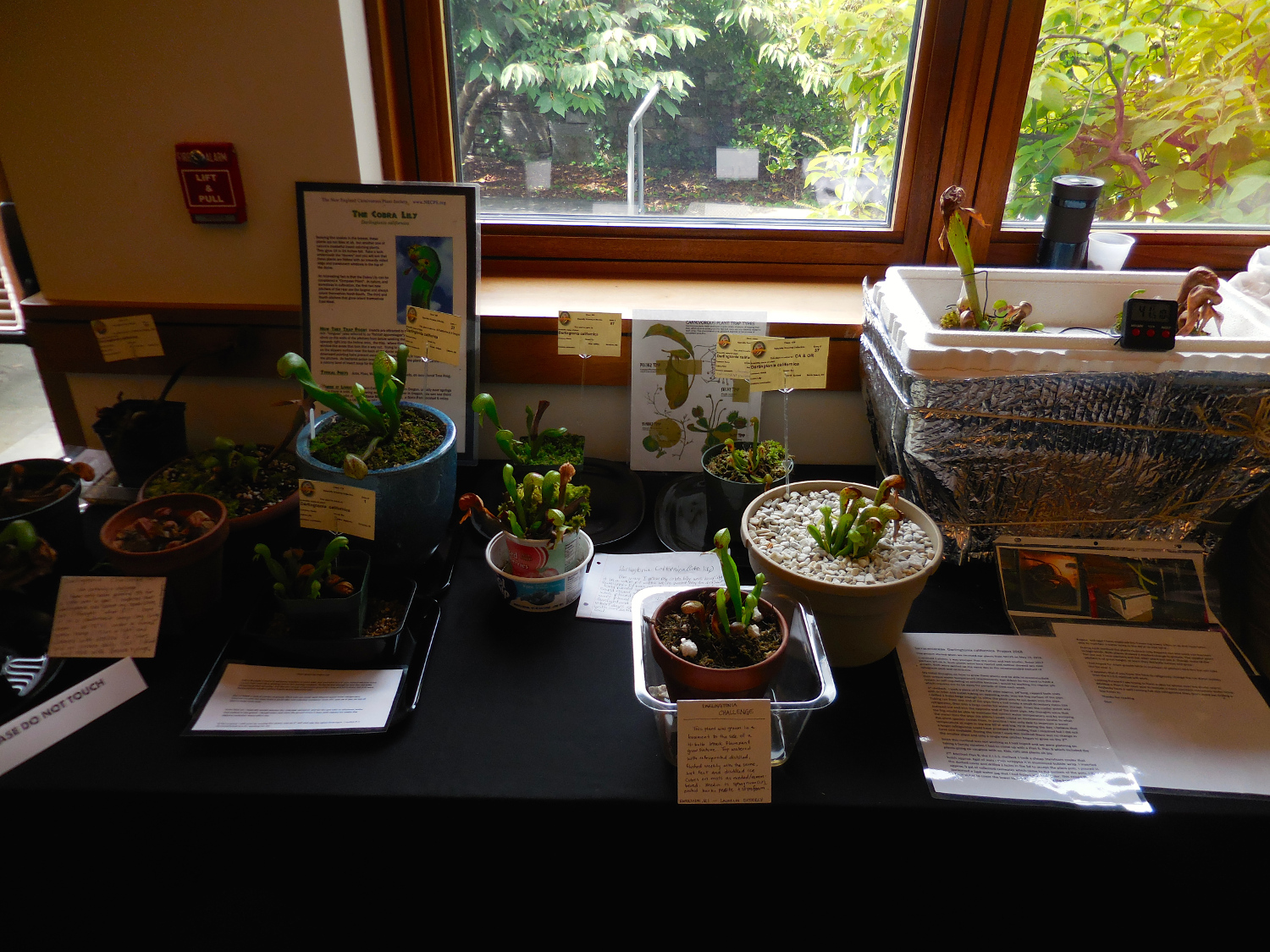
One of the special events at this year's show was the Cobra Lily Challenge. In general, Darlingtonia, the Cobra Lily, is difficult to grow in the Northeast and is poorly represented in shows. So back in June, the NECPS distributed divisions of Darlingtonia to interested members, in exchange for a promise to bring the plants back to display in September.

The Cobra Lily Challenge display. 
The main issue with cultivating Darlingtonia in this area seems to be that the plants like their roots kept cool, and suffer in hot muggy weather, especially when temperatures stay warm all night. People have tried various tricks, like irrigating with ice water or keeping plants in air conditioned terrariums, but the some of the best results were with plants grown mainly outdoors, but protected from the worst of this summer's heatwaves by, e.g., bringing them temporarily indoors in air conditioned spaces under lights.

Drosera, Drosophyllum, Utricularia and others in the show. 

Sarracenia leucophylla. 
There were a number of interesting talks at the show, in particular a presentation by Prof. Larry Mellichamp of the University of North Carolina, on the question of how the American Pitcher Plants (Sarracenia)  avoid trapping potential pollinating insects. The various species of Sarracenia produce pitcher traps and flowers at different times of the year, separated at different heights, and/or with different attractants that draw in separate populations of prey insects and pollinators. Sarracenia leucophylla, for instance, produces dark maroon, bumblebee-pollinated flowers in spring, while its largest, most effective traps emerge in summer and autumn, and use sweet odors and pure white coloration to attract moths at night.

Monday, September 11, 2017

Carnivorous Plant Show

Nepenthes edwardsiana at the New England Carnivorous Plant Society Show.
The New England Carnivorous Plant Society held its annual show this past weekend, and as usual the membership displayed and sold a fantastic array of plants. Attendance was excellent, as well, with something around 1500 visitors on Saturday alone. The show took place at Tower Hill Botanical Garden in Massachusetts, Worcester County Horticultural Society's immaculately maintained complex in the Worcester suburbs. In earlier phases of the NECPS's existence, the show was held at Roger Williams Park in Providence (and one time at the University of Rhode Island), but the event has become a popular autumn tradition at Tower Hill over the past couple of years.

Visitors to the carnivorous plant show, Saturday Morning.

The American Pitcher Plant (Sarracenia) table was packed solid with plants.

Emmi K's comprehensive collection of the bladderworts (Utricularia) of New England. Emmi and some friends travel around to swamps and bogs in the summer, collecting bladderwort specimens, then use the plants to create an educational display.

A big pot of a giant Venus' Flytrap cultivar, Dionaea muscipula 'B52'. The name B52 apparently derives from a label code in Henning Von Schmeling's flytrap breeding program, and has nothing to do with the bomber (or the band).

The very rare and almost shrub-like South American pitcher plant Heliamphora tatei.

Another "Sun Pitcher" species that is almost never seen in cultivation, Heliamphora sarracenioides.

An art installation made of woven saplings on the Tower Hill grounds: "Wild Rumpus" by Patrick Dougherty.

Tuesday, November 9, 2010

Frozen Flytraps


Connecticut got its first slushy snowfall of the season yesterday, and I took this photo of the Venus' Flytraps (Dionaea muscipula) in pots outside of the UConn biology greenhouses. They'll be fine, and can in fact take quite a bit more cold than this. Flytraps aren't tropical plants at all, and in their native land (the coastal Carolinas), they are dormant in winter and receive a fair amount of frost, and the occasional snow. New England winters might be too much for them, though, especially fully exposed to the elements in pots out of the ground, so I'll soon move them to a refrigerated room (temps just above freezing) for a couple more months of cold dormancy.

Planted in the ground, Dionaea can sometimes survive winters in southern New England, even without mulch or other extra protection. I've seen plants make it through several years in local bog gardens, though they seem to suffer a bit in colder than average years, and don't come back in spring 100% of the time. With a mulch of pine needles, they seem to be pretty reliable.