Monday, April 22, 2013

Sceletium tortuosum


South Africa has a rich tradition of using native plants in folk medicines. One of the most famous examples is Kougoed or Kanna, the fermented and dried leaves of Sceletium tortuosum, which is supposed to be effective against a huge range of maladies. Like various other members of the family Aizoaceae (the mesembs or ice plants), Sceletium tissues contain mesembrine and other alkaloids, which are known to have psychoactive properties. The plant has been subject to a certain amount of legitimate pharmacological research, and also--as an internet search will quickly show--a whole lot of enthusiastic amateur experimentation and attempts at commercialization.

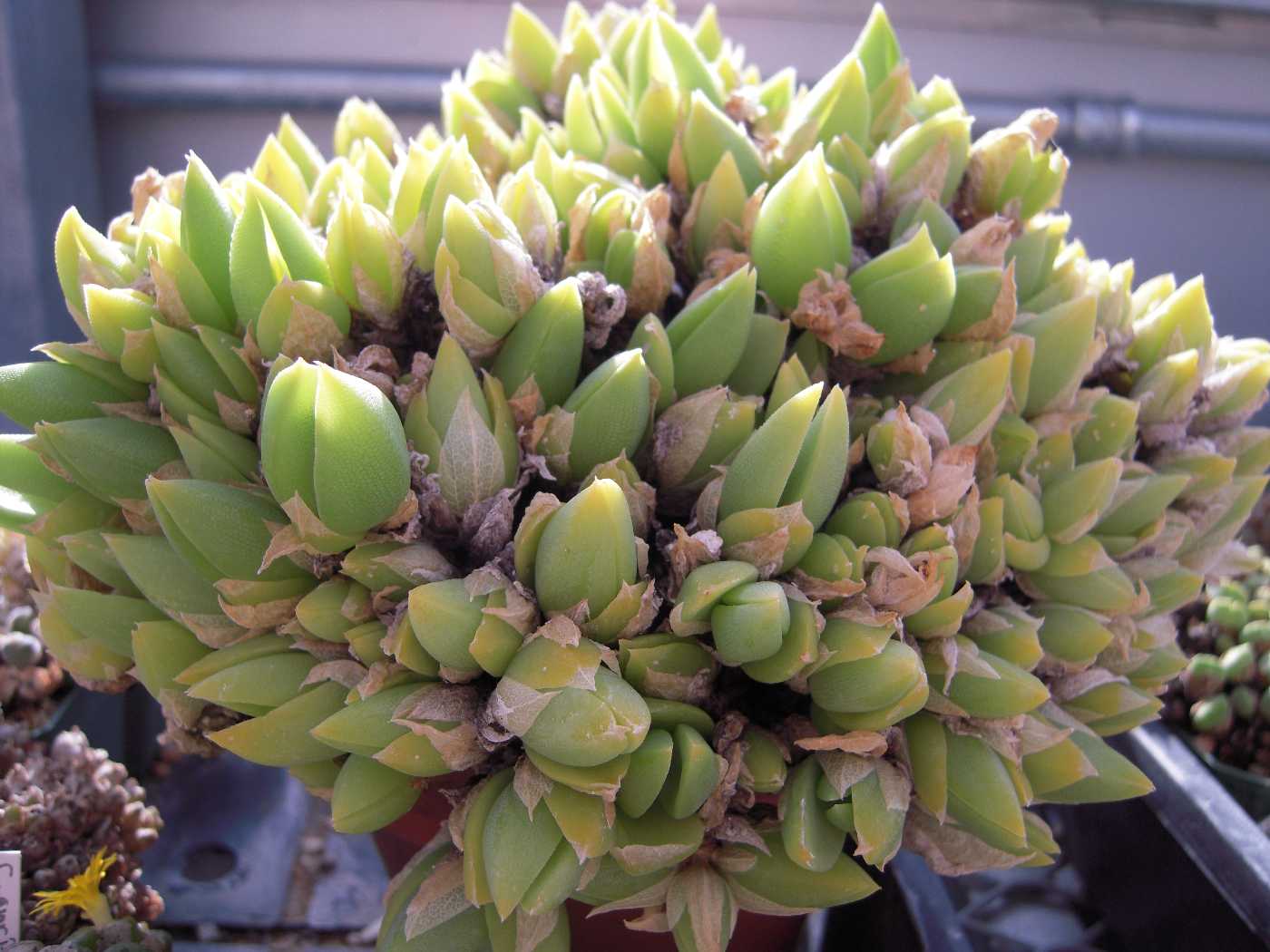
The genus name Sceletium was inspired by the skeletal venation that is visible in old, dried leaves. The dead leaves of S. tortuosum persist for some time, and during the dry season act as protective scales over the living shoot tips. Some authors place the eight or so accepted species of Sceletium within the larger genus Mesembryanthemum.

Sceletium tortuosum at Kruisrivier, in the Little Karoo in August (late winter).

Sceletium tortuosum is very broadly distributed in the arid parts of western and southern South Africa. Its habitat is primarily in a winter-rainfall climate, but edges into summer-rain areas in the east. Cultivated plants grow most vigorously in winter, but can be tempted into a certain level of summer activity if water is available. Possibly the preferred seasonality of growth depends on the collection locality; I would expect that plants from the west in Namaqualand would be more strongly inclined towards winter growth. In cultivation, plants look best if given as much sun as possible, and quickly become thin, scraggly and unattractive if light levels are inadequate. Otherwise, Sceletium presents no particular problems in cultivation, and is easily propagated from stem cuttings.  

References:
Chesselet, P. 2005. Sceletium tortuosum PlantZAfrica page. http://www.plantzafrica.com/plantqrs/scelettort.htm
Gerbaulet, M. 2001. Sceletium.  Illustrated Handbook of Succulent Plants, Aizoaceae F-Z, Springer-Verlag, Berlin, Heidelberg, New York.


Thursday, April 4, 2013

CCSS Show and Sale 2013


The Connecticut Cactus and Succulent Society is having its annual show and sale this weekend at Naugatuck Valley Community College in Waterbury, Ct. This photo was was from the show setup in a previous year, so while I can't guarantee that this particular Pachypodium will be making an appearance, I am reasonably certain that equally spectacular plants will be on display. As always, admission to the show and lectures is free of charge, and if you get there first thing in the morning, you might get a free plant, too.

We'll have our usual excellent selection of plant and supply vendors, too. One regular, Bob Smoley's Gardenworld, will unfortunately not be in attendance because Bob is recovering from an illness. However, we are adding some exciting additional plant sellers this year: Susan Amoy, Glen Lord, and Rick Logee's recently opened WRC Greenhouses. It looks like the weekend weather will be fine, so I hope to have a great turnout!

Thursday, February 28, 2013

February 28 Sugaring


The '13 sugaring season so far has been pretty good so far. There have been a few short stretches where it was too cold and the trees stayed frozen all day, and some rainy periods where it didn't freeze at night and the sap petered out, but more days with a decent flow and a number of excellent days where each tap yielded a gallon or more. The first week's production was 3.25 cups of amber syrup from 10 gallons of sap (about a 48:1 ratio). The second week's operation yielded about 2 cups of clear golden syrup; the lightening of the color was probably because of a stretch of colder weather. 


 Here's a photo of a sap icicle on a sugar maple on the UConn campus last week, forming on a wound that the tree sustained over the winter. The tan tips on the sapsicle are where freezing and sublimation of ice have concentrated the sugar solution down to something that is probably pretty close to being natural maple syrup, if only a few drops of it. You can imagine that this sort of occurrence was how the Native Americans first got the idea for maple sugaring. 

Sunday, February 10, 2013

Sugaring Season Start


I'm just getting done with shoveling out from the Blizzard of 2013 (and putting up a new mailbox, the old one having been pretty much finished off by the plows this time). The weather was very sunny and somewhat above freezing today, so I decided to try tapping the sugar maples. Success! Before the sun went down there was actually a strong flow, with an inch or two accumulating in the bottom of the buckets in the hour that the trees had between tap placement and the evening chill putting an end to the sugaring action for the day. Tomorrow is supposed to be a little warmer but rainy. Overall the forecast is for moderate temperatures and strong day/night temperature swings, so there should be some good sap runs.


In other locally-produced-sugary-substances news, the bee colonies have made it through the winter so far. I can hear faint buzzing from inside them, at any rate. They're pretty well covered in snow now, which should help keep them insulated from cold and wind.

Thursday, January 17, 2013

Canarina


Canarina canariensis is a tuberous vine endemic to (the 7th grade geography students out there are probably way ahead of me) the Canary Islands, off the coast of Morocco. It's a member of the family Campanulaceae, the bellflowers. The straggly stems produced by the tuber bear one to several large and strikingly colored flowers at their tips, during the depths of winter. The flowers lack any fragrance but literally drip with sugary nectar, which together with their shape and coloration suggest that they are primarily pollinated by birds. The flowers persist for an amazingly long time, with individual blooms lasting for almost a month.

The Canaries mostly have a Mediterranean climate, and the plant life from the islands is generally adapted to a winter-rainfall regime. Canarina canariensis is a strict winter grower, with the tubers sprouting in autumn, growing for six months or so, then shedding all of their above ground parts as the days get warmer and longer in the spring. I store the Canarina pots almost dry for the summer dormant period, with just an occasional splash of water to keep a little moisture below the soil surface. During the winter, the growing plants are kept in a cool, sunny greenhouse, given a shot of balanced liquid fertilizer every few weeks and watered to keep the soil consistently moist. Canarina shoots are waxy and somewhat succulent, and the plants are fairly thrifty with water even when in full growth. 

The C. canariensis plants here at UConn derive from seed collected by Dr. Greg Anderson on the island of Tenerife. The seed packet had been sitting around an office for seven years before Greg handed it off to me, and I planted the entire batch at once in a single pot, hoping to maybe get a couple of seedlings, if I was lucky. The pot was soon a lawn of little green shoots; it seems that Canarina seed remains viable for a long time. Separated out into individual pots of loose, well-drained soil, the plants reached maturity after one or two winters.