Sunday, April 25, 2010

Conophytum bachelorum: the Bachelors’ Cone Plant

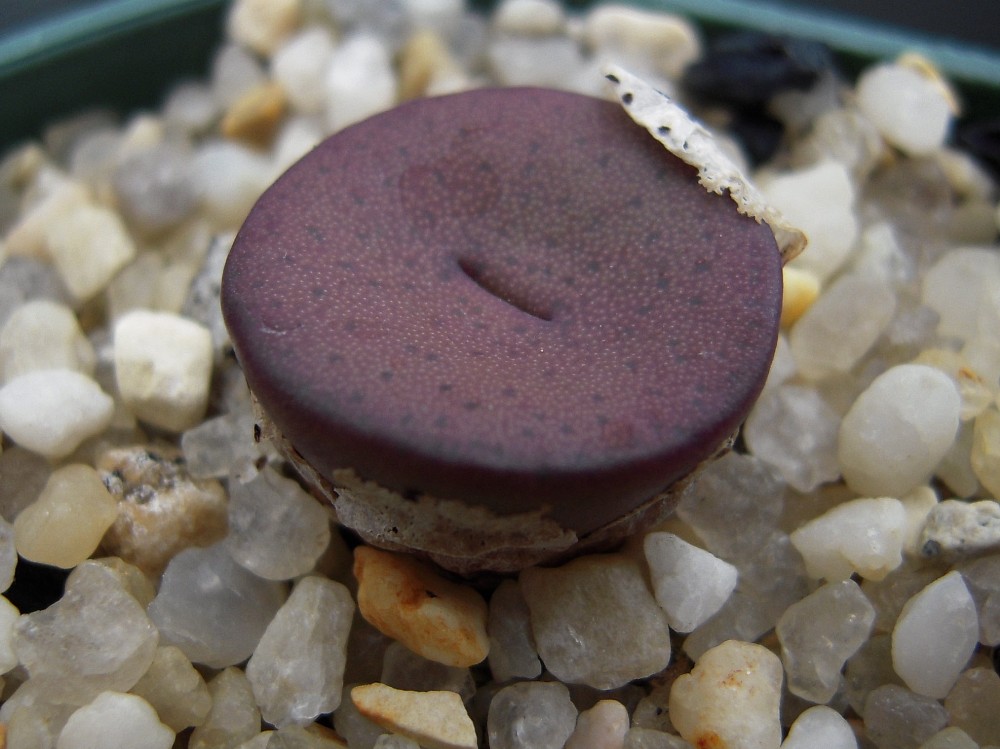
Conophytum bachelorum, with fresh leaves in September (the cone-shaped body is a pair of fused leaves containing water-storing tissue).

The whereabouts of Conophytum bachelorum was a long term, vexing mystery for students of mesembs (succulent plants in the family Aizoaceae) and living stones. Discovered in the late 1970s, the distinctively purplish button-like succulent was missing in action for decades, known only from dried herbarium specimens and a single living individual cultivated in England. In 2004, C. bachelorum was rediscovered on an obscure quartzite hill in the sparsely populated northwestern corner of South Africa, and a few seeds eventually made their way to mesemb enthusiasts such as myself.

As with many winter-active South African natives, the seeds germinated and grew strongly when planted in early autumn, and coddled for their early years with bright sun and regular doses of dilute fertilizer in the cool months, and some shade and misting in summer to prevent scorching. Conophytum bachelorum seems to be especially sensitive to summer sunburn, which proved fatal to seedlings in the collections of several experienced growers. In the wild, the plants grow close enough to the coast to experience frequent fog, which may explain how they get by in Namaqualand while having such thin skins.

Conophytum bachelorum in flower in March.

Conophytum bachelorum’s schedule not quite the same as that of the typical Conophytum. The plants flower over an extended period in spring, whereas the overwhelming majority of conos bloom in early autumn. The growing season of C. bachelorum is unusually early, with plants showing a strong tendency to start growing in the waning days of summer if water is available, and to go dormant in late winter (March or even February in the northern hemisphere), weeks or months before most winter-growers fold up shop. As a consequence, the plants flower when they look dormant, covered over by the freshly dried remains of their old leaves.

Young C. bachelorum plants in cultivation, dating from the rediscovery of the wild population, are now flowering and setting seed on a regular basis in several collections around the world. It may be a few more years, but soon enough this neat little succulent should become more generally available.

Thursday, April 1, 2010

Miraculotuberum, a New Caudiciform Succulent

Exciting discoveries in the plant world always seem to come from remote mountains in strange and foreign places, such as Canada. It came as a shock to the botanical community when a large and distinctive new caudex-forming succulent plant—Miraculotuberum stopandshopensis—was found right here in the northeastern United States.

Miraculotuberum stopandshopensis in the greenhouse of an anonymous collector.

Miraculotuberum was first collected in 2008, near Nyack, New York, by famed explorer and succulent plant enthusiast Dr. Don Javranos, seen in this video discussing his find. Little is known about the plant’s habitat, and the exact location is being kept secret. Presumably, M. stopandshopensis grows in a temperate desert environment, although desert conditions are uncommon in suburban New York. The plant exhibits several adaptations to life in an arid climate, including an absence of foliage leaves, and a thick waxy coating to prevent desiccation. The spectacular caudex of Miraculotuberum has a bitter taste and sulfurous smell, which deter herbivory by animals and children.

In cultivation, Miraculotuberum is challenging, and plants frequently fail to establish even under the best conditions. Given its northern range, Miraculotuberum is probably winter-hardy, and might make for an interesting addition to an outdoor cactus and succulent bed. Plants are not yet widely available, though they are offered on eBay, where large specimens imported from New York have sparked bidding wars among growers of caudiciform plants, and sold for thousands of dollars. Ironically, it is rumored that ignorant local people in Miraculotuberum’s native habitat sell specimen-size plants to unscrupulous nurserymen for as little as 19 cents per pound.

Saturday, March 27, 2010

Signs of Spring

Galanthus nivalis

I caught this clump of snowdrops during the freakishly warm weather last weekend. Temperatures have cooled off since then, but the snowdrops have faded, and a few daffodils located in warm sites are starting to open up.

Wednesday, March 17, 2010

King Protea


Protea cynaroides or King Protea, the national flower of South Africa, is doing its thing in the UConn greenhouses right now. The flowers (technically flowering shoots composed of many small florets) last for weeks, and there are a couple of additional buds developing, so there should be a nice show for the rest of the spring. The bloom in the photo is the size of a dinner plate. It has a funny sort of chemical smell, not exactly floral but not unpleasant either. The artists among my readership might be reminded of the smell of kneaded eraser.

Nothern greenhouse collections don't seem to include proteas very often, which is a shame. They're not overly difficult in cultivation, and this King Protea flowers every year in Connecticut. I use a nutrient-poor, acidic soil (5 peat moss : 2 perlite : 1 horticultural charcoal), and keep the plants in a very sunny spot in a cool greenhouse. Members of the family Proteaceae are said to be sensitive to excess phosphorous, so it's probably best to fertilize cautiously, using a high-nitrogen formulation.

Friday, March 12, 2010

Marsh Botanic Gardens Hosts the CCSS

Last weekend, the Connecticut Cactus and Succulent Society held their monthly meeting at Yale's Marsh Botanic Gardens. The weather was about as good as it gets in early March, with lots of sun and jacket-free temperatures, and at least 40 people showed up. I was really impressed by the new greenhouses at Marsh, which just opened up last month. The desert plant room wasn't completely finished, but what was there looked great. I'm looking forward to returning sometime to see how they have progressed in filling up all that new space.

The cactus club inspects the new desert collection.

Curator Dave G. also let us tour the old Lord and Burnham greenhouses at Marsh B.G., which are much more cramped than the new facility, as well as being prone to flooding in rainy weather.